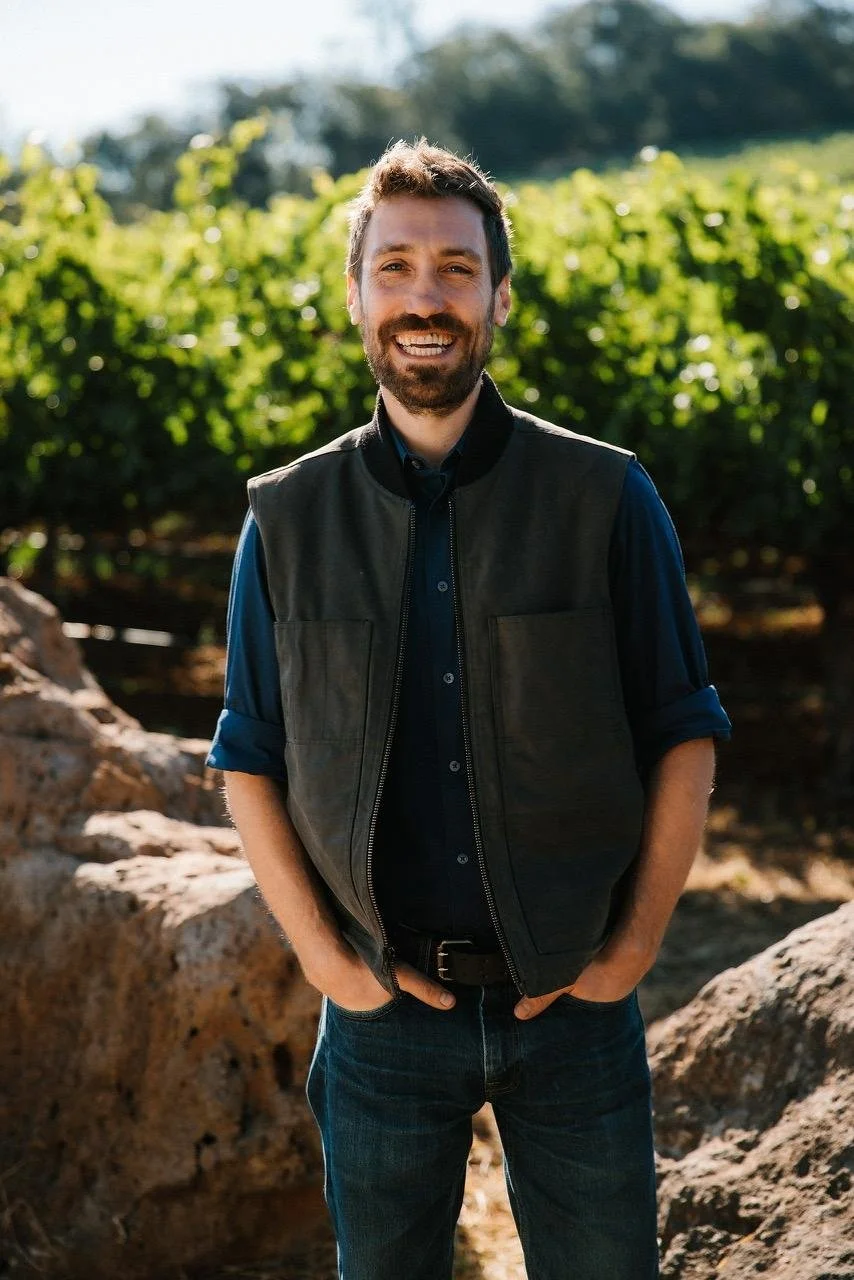
Ry Richards - Chappellet Winery
In this episode, I talk with Ry Richards, winemaker at Chappellet on Pritchard Hill, about his circuitous path from selling wine in high school to learning enology on the job and growing into his current leadership role. Ry describes Chappellet’s long‑tenured, family‑driven culture, their production team structure, and the importance of process, communication, and harvest “flow state” in managing complex vintages. We dig into recent and challenging Napa vintages (2011, 2013, 2021, 2023, 2025), shatter and low yields in 2026, and how drought, heat, and smoke have reshaped decision‑making. Ry also details Chappellet’s estate and sourced vineyards on the Vaca range, their work with Chenin Blanc, Chardonnay, Viognier, and Bordeaux reds, and why Chenin and site‑specific hillside Cabernet remain central to their identity. Along the way we cover yeast strategy, bottling realities, replanting and trellis choices on steep slopes, the unique trademarked status of Pritchard Hill, and why, despite market headwinds, he stays optimistic and rooted in the idea that wine and visiting Chappellet should fundamentally be about joy.
Resources from this Episode
This podcast is sponsored by InnoVint.
Wineries of all sizes rely on InnoVint’s winery operating system to optimize vineyard tracking, manage wine production processes, automate compliance reporting, track costs seamlessly, and make data-driven decisions.
The best part? The software is intuitive, easy to use, and mobile and offline friendly! And with the highest-rated customer service in the industry, you’re guaranteed to have a smooth transition, even right before harvest.
Learn more: innovint.us
Get a demo: innovint.us/request-a-demo/
Join our free winemaking community: innovint.us/join-the-punchdown/
Check out the Fundamentals of Winemaking Made Easy video course
-
Episode 222: Ry Richards - Chappellet Winery
Recorded: September, 2026
Jim Duane: Sometimes these conversations with my friends, my close friends, are the most difficult, because I know the answers. I don't want to ask you questions I already know the answer to. But for the sake of people who don't know you, I'm going to ask some things. Please start and let everyone know how you came to get into winemaking.
Ry Richards: Sure. My name's Ry Richards. I've been working at Chappellet now for this is my 20th vintage there.
Jim Duane: 20th.
Ry Richards: 20th, yeah.
Jim Duane: Very cool.
Ry Richards: Yeah, ripe old age now, but not really. We'll get into that later. How I got into winemaking was a circuitous path. I started selling wine in a shop in high school. I was 16, in the East Bay. I was at a Whole Foods in San Ramon. This guy John was super open-minded, and he knew I was curious, so when the distributors would drag their bag through, I would taste with him in the back. I had a spittoon labeled "Ry's Illegal Spittoon," and that kind of started the wine curiosity.
I worked there, then went to college at UCLA for pre-med. I was put on some immunosuppressants, and medical school kind of went away. The idea of going into medicine went with it. I thought, well, I love wine, I like science, let's see what that's about. I got an internship through some family connections, actually kind of through Chappellet. My parents knew some Chappellets from way back, in art college, and I got an internship at William Harrison Winery, where I met Philip Titus. That would be harvest 2006.
Jim Duane: Philip, who I've had on the podcast, could you explain his progression through Chappellet? He's been there a long time. Chappellet is one of those places that's had very few winemakers through its long history, right?
Ry Richards: That's right. Philip Titus's first vintages were in the early '80s. He was there in '82, '83, '84 with Cathy Corison, and then he left for a little while, and came back in the early '90s, 1990, '91, and he's been there ever since. That's a big piece of Chappellet, I think. I'll bring this up more as we talk, but the legacy of people there, how long people call Chappellet their home, it's almost like part of the tour of Pritchard Hill. You have people like Philip, 40 years. Our previous vineyard manager, Dave Pirio, similar trajectory, about 40 years, then retired. Our vineyard foreman, Enrique, we joke that he came with the property. He'd been there 55 years, and he just retired two weeks ago.
Jim Duane: Wow.
Ry Richards: So at a nascent 20 years, I'm still the junior squad in a lot of ways, and I think that's a big reason I've stayed. The rest of my history in winemaking is starting off in the cellar and transitioning all the way through to winemaker today.
Jim Duane: Okay, so what is Philip's current position? Is he retired?
Ry Richards: Philip is an advisor, a senior winemaking advisor. I see him daily. The rest of the company does too.
Jim Duane: Doesn't sound like retired.
Ry Richards: Daily doesn't sound right, does it. The magical thing about Philip Titus is that he's got more and more energy all the time. He consults with us on blending, on vineyard decisions. With the winemaking and vit team, he's still as involved as ever. He gets to leave and go fishing every now and then, but he's still super engaged, and we want it to be that way. It's that legacy, building forward generational continuity. It's a big piece of the Chappellet mentality. Molly and Don bought the property and started the winery 60 years ago, the second generation came in and has been running it for a while, and now we're doing that with winemaking and grape growing too, because Andrew Opatz is my direct equivalent in the vineyard. He started one year after me, working with his uncle, Dave. Keeping that craftsmanship alive is a big part of who we are.
Jim Duane: Why do you think people stay so long? I'm sorry, that was poorly worded. There's a reason people stay for a long time. At some level it boils down to the fact that they're happy, they like their job, they like the people they work with. What do you think it is?
Ry Richards: I think it's the family. That really comes from the leadership of the family at Chappellet. They value people's efforts. You're not only seen as someone who works there and tries to cultivate excellence, you're brought in on a very human level. They recognize every single person's efforts at every meeting. Cyril Chappellet does this great thing of recognizing every person's efforts from top to bottom, and I think that gives people a stickiness to Pritchard Hill. We want to be there. It's a wonderful place to work, as much as it is a place to grow excellent wine.
Jim Duane: And what does the rest of your production team look like in 2026?
Ry Richards: We have about 10 people on full-time staff in production winemaking, everybody from cellar to winemaker, and we bring on six interns.
Jim Duane: Tell me what that structure looks like.
Ry Richards: There are five people in the cellar, from cellar master to cellar positions, and three people in the lab, titled assistant winemaker. One is more enologically based, one is more logistics based, work ordering, that sort of thing. Then we have a gentleman who does operations, Daniel Docher. He's the one who makes everything happen. He was a winemaker in his past, at Hansel, before he came to Chappellet, and he's been there about 18 months longer than me. He has a great winemaking background, and a great technical know-how for setting up optical sorters, fixed presses, hot-wiring things. We have a lot of regeared equipment at Chappellet that most places don't have because of Daniel, and we do things a little differently than some houses because of that. And then there's me.
Jim Duane: So how would you describe your winemaking role? If Daniel's taking care of a lot of the operations, what is your current role?
Ry Richards: Daniel and I have always divided it well. He handles the machines of wine and the bottling, and mine is the day to day: the rackings, the coordinating, the blending, the vineyard liaison work. Winemakers don't get acknowledged for being taskmasters too. I think there's an undercurrent to the whole job where we get romanticized into the blender, the artist, and that is super important. But having a team you can rely on, process and SOPs and protocols, having good people you can trust, that's kind of been my wheelhouse. How do we take all of that, and, with over 20 years alongside Philip, help bolt it down more and more? How do we become as much tacticians as we are artists?
Jim Duane: Did you learn your enology on the job? I know you have a science background, but you didn't study enology specifically, correct?
Ry Richards: No, no formal study in enology. It was all on the job, via Philip and Chappellet and reading and experience. It helped to have that awareness from selling wine, knowing the lingo, but I can't say I knew anything coming in. I walked in the first day, loved it. I think what wedded me to wine was being all in during harvest: using your mind, your body, your senses, having to work with other people. It's a big coordination effort on all of your personhood, it takes a lot of energy, and I fundamentally like a harvest's chaos. It's keeping a lot of plates spinning, and I enjoy that. Chappellet is kind of a big little place too. It's not a super small winery, we have a good team size and structure, so you get to work with other people while doing all of it.
Jim Duane: How many tons do you expect to process this year?
Ry Richards: This year is going to be light because of the harvest. With set and shatter this year, which I've seen walking the fields, one very veteran grower referred to it as almost magnificent, because the amount of shatter out there is uncanny. Chappellet year in and year out is usually around 1,000 tons, but this year we're going to be quite a bit off that.
Jim Duane: I've been surprised by how much I'm hearing about shatter now. It was certainly a discussion back in May during pollination, and I knew it was pretty bad over in Sonoma and some other places, but at Seavey, other than one block of young Merlot, we didn't really get hit with it. So I've been less aware of it, and now it's coming up more.
Ry Richards: You're incredibly lucky. I think Seavey's a bit of a diamond in the rough on that end of things. We not only have the estate, we source from vineyards all the way south, across from Napa College into Sugarloaf, and we're seeing shatter on Cabernet particularly badly. On the Ridges and Atlas Peak, we've actually got Malbec and Petit Verdot that shattered to close to 100 percent. There's no viable crop there.
Jim Duane: "Shatter" isn't really the right word at that point.
Ry Richards: No. You walk out and it looks like someone clipped all the rachises off, because they just aborted. If you look back at April, it was every bad thing that could happen during a set interval. The temperature would push up, then push back down. It was rainy, it was windy, it would get a little nicer, then rainy and windy again. This was not the best spring for crop load.
Jim Duane: Okay, so tell me the range of your growers, the varietals, and where you're sourcing grapes. We'll come back and talk about the estate.
Ry Richards: The way we approached that is really interesting. We only source hillsides on the Vaca side, so from Chappellet, as I said, south to right across from Napa College, Sugarloaf. There's a necklace of other vineyards, we get some fruit from Stagecoach, Edcora, Broken Rock. It was interesting, Dave and Philip would leave Pritchard Hill, and when they went somewhere, they'd look for a particular kind of rock, a particular look and feel, and exposure. Years later, we finally got the GIS out and looked at it, and they were really following the Hambrecht Rock Outcrop, which is at our Hideaway Vineyard on the estate, that flat red volcanic soil, younger volcanics than the north side of Pritchard Hill, which is Sobrante Loam. That Hambrecht Rock Outcrop series runs the spine of the Vaca Mountains from Pritchard Hill, around Lake County, St. Helena, and all the way south to Napa College and Sugarloaf. If you're on the right ridge, you're planted on that outcrop, and that's the terroir we identify with, really rocky terrain. Not unlike what you have at Seavey in a lot of ways, that rocky hillside. So we source and harvest other grapes away from the estate: Cabernet Sauvignon, Cabernet Franc, Petit Verdot, Malbec. Merlot is the only thing we don't have at the estate, because over the years we've figured out it's a little arduous of all varieties, so the Merlot comes basically just from Sugarloaf Ridge. On the estate, we've got predominantly Cabernet, two blocks of Cabernet Franc, Malbec, and then we also have Petit Verdot as well as Chenin Blanc.
Jim Duane: And is all the Chenin Blanc from the estate?
Ry Richards: Yeah.
Jim Duane: So I know there's not a lot to source and blend.
Ry Richards: Currently, right. We just talked about the shatter. The inspiring thing this year for me, in 2026, is that since about 2009 we've been operating on this one three-acre field of Chenin Blanc, and in the last year we've grafted over three more sites. So we'll be going up to six acres in total once we've fully transitioned. We have Chenin Blanc around 800 feet, another around 1,200 feet, and another around 1,500 feet, re-diversifying Chenin Blanc on Pritchard Hill, because it used to be planted in many different locations. It's refreshing, we get new blocks, more experimentation in the winery, but it's also a bit of a "from whence we came," Pritchard Hill coming back to itself, back to the '60s in a way, obviously in a much more modern form. We went from picking the three-acre field once, to twice, and this year we had about nine or ten different picks, which is cool, because in the wine room you get this great diversification of timing, of pick areas, of blocks, and all the different iterations you can do: stainless, old wood, one-year wood, some new wood. Experimentation is alive and well.
Jim Duane: So that means you're grafting blocks over to Chenin Blanc.
Ry Richards: I'd say Molly Chappellet was way ahead of the curve. Chenin Blanc went through this whole super-cycle into the '80s, when it was a predominant white grape. I've heard statistics of Napa Valley being up to 1,900 acres of Chenin Blanc at one point. Last crop report, it was something like 18 bearing acres in all of Napa Valley, and Pritchard Hill is going to represent six of that this year. So she's kind of the queen of Chenin Blanc in a lot of ways.
Jim Duane: So how would you describe the style of that wine? Because this isn't a hipster house, you're not natural winemakers.
Ry Richards: Right, and I think that's the beautiful thing about that wine. I feel like the less you do to it, the more marvelous it is. It's almost the least amount of winemaking. We ferment it, it's super simple, the recipe goes back to the '60s. About half in stainless steel to keep the brilliance, and about half in French oak to get the rounded-out, barrel-fermented mouthfeel, and then you put those back together, and usually that's where you land on your blend. We've tried other things, little bits of concrete, and Philip tried malolactic fermentation on it earlier, but a lot of those things detract from the very simple elegance that Chenin Blanc has. You have to step back a little and not fuss so much.
Jim Duane: What other whites do you make? Chardonnay, right?
Ry Richards: Yeah, we make Chardonnay from Sangiacomo, from the Keizer Vineyard, and from Wente and Robert Young clones predominantly.
Jim Duane: So we're talking Sonoma now.
Ry Richards: Sonoma, right off San Pablo Bay. We've been working with the Sangiacomos since the early '90s, so they know exactly what we want. We've landed on this home vineyard called Keizer. It's all 100 percent barrel-fermented Chardonnay, about 70 percent malolactic, and we arrest the other 30 percent to keep freshness. We don't stir unless we're promoting malolactic, just to keep things verved up. We want a certain amount of acid and freshness, that level of perk in Chardonnay. We don't want it exhausted by too much oxidation.
Jim Duane: What kind of malic acid levels do you pull in that Chardonnay? What do you tend to see?
Ry Richards: They can be high. You can be in the four range.
Jim Duane: Okay, that's real.
Ry Richards: Two and a half, and we've seen as high as six on the old Wente. That's the stuff we'd choose not to push through malolactic, because it gets so tired by the time you get to the end, you've cashed out on the fruit. That fermentation is going to be rigorous. Particularly with the old Wente, where you see those really high malates, you also see high pH, high TA, high nitrogen, they're just high everything. We have one site that's a non-ML fermentation, that's where you keep the brilliance, and the Wentes tend to have that oily, rich mouthfeel intrinsically. Choosing when to step back off of that, and on the Robert Youngs we pursue malolactic more full-throated. They still have enough of that key lime, citrus, lemon peel character to get through the malo and keep the tropical notes. I think that's why we're attracted to those clones and not so much clone four, where you get more pear, apple character.
Jim Duane: Speaking of pear, my Chardonnay's mid-fermentation right now, and every year, and it's just a couple small blocks of Chardonnay, a minority of the vineyard, once I'm below 15 brix, it's just pear. Not fresh pear, canned pear.
Ry Richards: Oh, yeah.
Jim Duane: It's a very nice aroma, and everyone who's working with me seasonally gets excited about it. I tell them, enjoy it while it's here, because it goes away. When the wine is finished, you won't taste any pear at all. It's the most fleeting, in-and-out aroma.
Ry Richards: We have this block, 13B out of Keizer, Robert Young clone, and right now, mid-fermentation, it smells like someone's preserving nectarines or peaches in the kitchen. Canned peaches, floral, stone fruit like crazy. I love that. It's one of those things in winemaking you can't experience unless you're in production.
Jim Duane: Right, you don't get it otherwise.
Ry Richards: It's almost like Chardonnay or Chenin Blanc right before you SO2 them, when they're done fermenting. It's the best they'll ever be, in a way, so bright and fruity. I love that phase. Making white wine is so fun, but you can't give that moment away. It's transient.
Jim Duane: All right. So Chenin, Chardonnay, any other whites?
Ry Richards: A little bit of Viognier, just a tiny bit, for the club, out of Russian River. It's that tip of Russian River that almost goes out to Windsor, behind the Santa Rosa airport. We like that site because it's cool, and you get fruit that preserves its acid.
Jim Duane: Which is hard to do.
Ry Richards: Right, because usually the brix run up and the acid blows off, and you end up with a big, unctuous Condrieu-style Viognier. We've made those in the past, high alcohol. This is a very different style. We tend to pick it a little lower, in that 22 to 23 range, because it has all the flavor at that point, and we don't want the alcohol to build up. We ferment it much like the Chenin Blanc, non-malolactic, about half French oak barrels and half stainless steel, again to provide brilliance. We had one harvest come in a little rich, and decided not to do it all in wood, to get some stainless effect for diversity. The more diversity you can build into a program, it's like having more paintbrushes to paint with. Obviously you don't want to run yourself crazy, I'm not a believer in running twelve different yeast strains at once. I want good, clean ferments, but we also want diversity.
Jim Duane: So for your reds, that brings up a good question about yeast. If you're inoculating, do you tend to stick with one yeast and go for it for the season, rather than trying to hit every flavor on the spectrum?
Ry Richards: We use RP15 a lot because it's a workhorse. It handles the temperature of fermentation well, doesn't tend to stink. I think, maybe it's a little old-school, but you want a yeast that just does its job.
Jim Duane: I totally agree.
Ry Richards: Right, you want something that ferments cleanly, does its job, goes dry, and then you get to embark on elevage, and hopefully you've done the work on extraction and pump-overs to get that wine into the right spot, and the yeast is really just a catalyst for that.
Jim Duane: I totally agree. I think the handbooks the enological suppliers put out should have a caveat before the yeast chapter that just says 90 percent of what follows doesn't matter. My intern has so many questions about yeast, and I tell him, it matters for aromatic whites, for rosés, for stuff that's in and out quick. But for anything aged over a year, get a clean ferment, that's it.
Ry Richards: A failed fermentation is so much more damaging than whether it has a little more red cherry or not. I think keeping things clean matters. We talk about this at Chappellet a lot. We work so hard in the vineyard for a whole year, and all those efforts of people in the field, working through rain or early season frost, they're out there growing really wonderful fruit. Our job in the winery is to respect those efforts, to do our very best. Being lazy about it, just trying something to try it, isn't good enough. You have to push to get better, but mitigating your biggest risks is a big part of the job.
Jim Duane: Let's talk about some of the difficult vintages. You've been there 20 years, you've seen a lot. For me, starting at Seavey in 2011 was a big bookend to that chapter. Prior to 2011, what vintages stand out as real challenges to you?
Ry Richards: '11 is the telltale one. It just rained.
Jim Duane: It rained in a season where the grapes weren't getting ripe.
Ry Richards: That's right. We've been talking about this more lately, what were the difficult ones? '11, but you learn from '11, and within a year you can apply that. 2025 was a difficult vintage too, a big crop, cold, and it rained, so how do you get everything in before the rain, how do you ripen? But we had more tools than we had in '11, so I think that was a good success. In vintages like '11 or '25 it's about how you pull as much out of those grapes as you can, because the extraction is a little light, and you want to build the wines up. But learning from Philip, on a place as rigorous as Pritchard Hill, some of the hardest vintages are the really tannic ones, the vintages where the wines are freight trains of extract. 2013 was very much like that, big tannins, and the question becomes how you ferment quickly, get what you want out of those skins, and depart, so you don't make wines so tannic they lack grace or elegance. I think 13 and 21 are parallels, that deep drought, lower crop, high extract character. That's been a big reason I've stayed at Chappellet this long, to access that kind of institutional memory. Philip can go back into the '90s and provide those examples, '98 for '11, and now we're starting to draw the same parallels in modern vintages, '11 reminds me of '25, '13 reminds me of '21, '16 and '23. Andrew Opatz and I talk about this on the drive home from the hill, along Silverado Trail, reflecting on the day. The last six years have just been so dynamic. 2021, huge drought. 2022, hottest vintage on record. 2023, coldest, really long harvest. Smoke in 2020. There's so much changing vintage to vintage. I think we're just on deck for more of that.
Jim Duane: What are some of your favorite vintages, ones that maybe don't get as much attention because they're not extreme?
Ry Richards: I love 2019.
Jim Duane: Okay, why?
Ry Richards: The wines are great, real blue bloods, deep, saturated, a lot of complexity, and I think their potential for age is off the charts. But the harvest interval itself was the lack of stress. It was this long, easy stretch, you started in September and went all the way to the end of October, and the vineyards were just out there, happy, growing moderately. It made a really good vintage, but on the back end you didn't have to race tanks, race a heat wave, race the rain. It just kind of behaved itself. The wine quality is great, but I remember it very peacefully, rather than racing out of heat like '22, or racing in before rain like '25. You were allowed to take your time, observe everything, and pick it right at the right moment.
Jim Duane: Slow and nice pace, but dark for me in 2019, because PG&E kept turning off our power that year, before we had our big generator. We had a little generator running off the back of a diesel tractor.
Ry Richards: Yeah.
Jim Duane: It gave us enough output to run the processing equipment, but not the lights and the chiller at the same time. So we'd turn off the lights, turn off the chiller, process the grapes, and...
Ry Richards: ...then reboot.
Jim Duane: Yeah, reboot.
Ry Richards: Oh my gosh. But I feel that. In 2022, our whole crush line was overheating. The old crush pad we had was having a lot of problems, freak drives running hot, so we had to hot-wire around them, Daniel and I put it together, running it in manual mode: you turn it on, you plug it in, it's on, no adjustments. We had mechanical failures in '22, not just from the heat, but from things having a hard time keeping pace. Those can be part of the stress load too, it's not just terroir and growing grapes, it's also just getting them safely into the winery. That flash-forwards to 2023, when we bought a whole new crush line. It can optically sort eight to ten tons an hour, and it changed the whole dynamic of harvest. We wouldn't have been able to do 2023 without it, it was so late, we ran 21 crush days back to back, but we had the technical throughput to do it. That's a big bottleneck for a lot of people, you improve your tank farm, that solves one thing, but if you don't improve your crush line, or you only have one press, that's the next bottleneck. When I started at Chappellet, we only had one press, we'd start pressing at five in the morning and go until eleven at night. Then we got a second press. Those incremental improvements over time are so important, and they take dedication. You have to have ownership that wants to participate in that, someone who says, you need more tools, let's get them.
Jim Duane: Gotta sell wine to get the tools, though.
Ry Richards: That's true. Very much so.
Jim Duane: How much do you get emotionally involved in the stresses and challenges? Because you're always going to be pulled in, you have to make decisions, it's your job to run logistics, to evaluate the problem. In something like a smoke vintage, you don't know the solution as you're making the wine, but you know day to day what you need to do. How much of that emotion are you able to wall off, or does it just suck you in?
Ry Richards: That's a great question, Jim. I like to hope I leave behind more of the bad emotions than I used to, and celebrate the wins more. I don't know. I think I have two faces on this one.
Jim Duane: I think I have to put up the strong, resilient face around other people, because when you're facing a real challenge, rain or heat or smoke, you can't freak out. You need to be the one saying, okay, this is the challenge, here's what we're going to do. But I get in the car on the drive home, and that's all I can think about. I'm very emotional about it internally, but I try to put up the stoic face.
Ry Richards: Yeah, no, I guess there is some of that. You want to feel calm and collected about what's going on, and in the end, we can't control the weather, we can only control what we control. I've only found this in the last few years, at some point you have to release a little of that, you're not the Lord of the universe, you're going to get this harvest done and do great work. For me the emotions come in almost as a state I can't turn off. I'm up at one or two in the morning thinking, I've got to do this, this, and this tomorrow, we need to pick that lot, we need to press, what's next for sampling. The emotions are very "on" during the whole harvest interval, and I actually like that phase. Once it all ends, and everything's in, the calm-down in November, I don't want to say it's depressive, but the bottom really comes out, the energy level drops way down. Harvest hangover is a real thing. That part is difficult, because once you've been racing that much, and you're on every day, you want to carry that energy through. Thankfully we don't have to, otherwise we'd all just...
Jim Duane: ...burn out.
Ry Richards: Yeah, we'd all just pass out.
Jim Duane: I love that energy. I don't like it at first, I'm slow to creep into it. Right now we've picked the whites, a little bit of Merlot, and I'm not in harvest energy yet.
Ry Richards: Yeah.
Jim Duane: But when I get in, I'm all in. And then there's going to be the letdown, and I hate the letdown.
Ry Richards: There's something to those days where you have to race, pressing tanks so you can fill them, so you can harvest the next day, and every movement is predicated on something happening before it. You press a tank so you can fill it, you barrel down so you can press another tank, and the whole team is working together. That synergy, when you get into it, feels so good to me. You're being creative, making sure the tannin's in the right place, measuring for color, all the complexities of actually making wine, but then that synergy is like when a band plays together and the rhythm just goes, you're all on the beat without having to think about it. Harvest hits a groove, a steady state you settle into, and eventually the whole team is vibing together, like a flow state. That feels really good. In years you can't get there, those are the harder years.
Jim Duane: So how do you communicate on a basic level, day to day, what the plan is for the team?
Ry Richards: We have meetings every morning.
Jim Duane: At the beginning of the day.
Ry Richards: Right, we usually start at seven, some people come a little earlier, but we all stand in the middle of the winery every single morning and communicate what's happening, what's coming in the next day, what the expectations are, who's doing what. Our cellar master, Bernabe, divvies up who's doing what task, and I usually give a forecast of what's coming, what to expect, and obviously there are tons of changes to that. You get to the one o'clock tasting, where you're tasting all the fermenters, and a lot of the plans laid in the morning nimbly change, to make sure every fermentation gets its due, gets each block, each set of wine, to its proper endpoint. We all congregate first thing every morning, all year long, and I think that's a really good ritual.
Jim Duane: That's a lot of communication, standing around.
Ry Richards: Staring at each other and talking about the day, but at the same time, I find that if you can't get out of that morning meeting efficiently, those are the days that run long and exhaust everybody. If we hit the ground running, we usually get good results.
Jim Duane: Kind of jealous. When I worked at larger wineries, we didn't have that full-team communication. I think it would've been really helpful. The cellar would have its own communication, but not everyone together.
Ry Richards: I think that's a really cool part of Chappellet, that we can do that. We're a ten-person team, plus six interns for harvest, so you get to know everybody well. It's not a team of thirty people. Many of us have worked together a long time, like I mentioned with the vineyard earlier. Bernabe, our cellar master, has been there since '89, salt of the earth, he keeps us going. And Valentine's been driving forklift there for at least 25, 30 years now. We've got a new guard, six years down to two years, and an old guard, 20 to 40 vintages, and I'm the youngest of that group. It's kind of cool.
Jim Duane: It's super cool. What are you excited about? What are you working on now, anything new for Chappellet?
Ry Richards: New for Chappellet, right now, is the release of the '23 vintage. There's so much fanfare about it, it's a big watershed moment for Chappellet in a lot of ways.
Jim Duane: How so?
Ry Richards: It took 56 years to get there. All the experience of Philip and Dave, their efforts of replanting starting through the '90s, all the way to current day as we still replant, the onboarding of Andrew and myself, that culmination of effort. We built a new barrel shed in 2012. All these things were clicking into place to be able to make a vintage like '23, because it's just a stellar vintage, and I'm excited for it to release, I think in October. It's a vintage where all those efforts and synergies, as much experience as effort, all come together. Like I said earlier about people being part of the tour, someone like Philip or Enrique who've put in so much deep experience, a vintage like 2023 is the payoff. You get to something like that and realize all those momentums landed. I'm also excited about the re-diversification of Chenin Blanc, seeing all those different facets of the variety, and more long term, we're constantly replanting, five to ten percent of the vineyard on a continuous basis. When I started, block four and block nine were the unbeatable blocks, and within the last two years they've become fallow ground. So what are those going to become again? It's cool to see that full cycle, they were contributing to Pritchard Hill, they were all in, and then slowly declined, and now we get to try again. Are we going to change spacing? Change clone? What are we going to do?
Jim Duane: Yeah, what will you do? I'm curious what you're thinking about in terms of trellis architecture and spacing. I'm less interested in clone and rootstock.
Ry Richards: Interesting. I think tightening up a little. We've talked a lot about six by four, but we're also seeing seven by three work out really well in some places.
Jim Duane: This is VSP?
Ry Richards: Yeah, or cane, just to make sure you've got enough budwood out, so you're not getting really long arm extensions. I think that's where we're seeing on the old eight by four, seven by four spacing, those bigger vines don't necessarily yield more product. But we're really looking at it from a quality angle. Seven by three, especially with cane pruning, gets a good push across the whole cane because it's pretty short, so you don't get the blank head and then dominance on the end. We're seeing if we can tighten that up a little. Obviously not every place on Pritchard Hill is good for that, because it's a pretty steep place.
Jim Duane: Right.
Ry Richards: So you can't always tighten up that well and still do all the underlying work you need to do, it's just really steep, and you have to take that into account too.
Jim Duane: How much do you have to contend with sunburn on your VSP? I ask this partly to give people context, because when you're on a hillside, much like Seavey, you don't always get to pick your ideal row orientation. Rarely, actually.
Ry Richards: Right. If you can get that ten degrees off north-south, it's great, because you bisect the sun in the sky, so each side gets equal treatment. But we don't always get that. So Andrew is always insistent on carrying cross arms on top, making sure there's enough leaf exposure to almost umbrella a bit, but not too much. It's dappled light over the clusters for protection, not going back to the '80s and doing full California sprawl with everything tucked under. We want exposure, but it's a dance, not stripping laterals out entirely, maybe pruning them to keep leaf surface area on the vine. Andrew and Stephanie talk about vines and leaves like they've got a whole other language for it. I'm a guest in the vineyard, we all work together, but their nuance in that area is way beyond mine. I think that's a big piece of modern grape growing and winemaking, it was romantic to think one person could specialize in all of it, but it's really hard now.
Jim Duane: Yeah, I think grape growing...
Ry Richards: ...is getting so much more technical, and winemaking is getting more technical all the time, so the two disciplines have to synergize and work together, and that's a big part of what we do at Chappellet, constantly working together. As much as I'd love to be out in the field all the time making wine, I don't have the time, I'm out there through the season, but they're the experts.
Jim Duane: I don't think I talked to Philip about Pritchard Hill and the naming convention, so maybe you could bring everyone up to speed. What is Pritchard Hill, who can use that name, what are the legal boundaries of it?
Ry Richards: Pritchard Hill is a viticultural area, but it's not an AVA, and it won't be. The Chappellet family trademarked Pritchard Hill, Don Chappellet trademarked it, so they're the singular owners of the name, and they lend it out to our neighbors to use on their back labels. Part of the reason they defend that fiercely is, if you look at anyone who's gone through the AVA sub-appellation application process, those areas don't stay small, they tend to get bigger, more broad, the lines go outside the original boundaries. The Chappellets feel passionate that Pritchard Hill should remain a very small, very specific spot, because it truly is one, and that's why it's still defended that way, as their trademark.
Jim Duane: Is there a clear geographic delineation of that area?
Ry Richards: No, that would be fun. That would be a whole podcast for Cyril Chappellet. They own the trademark, and they lend it out to neighbors they agree can use it, because they want messaging for Pritchard Hill, since it's a really important piece of ground. But they also recognize that if an AVA expands and suddenly part of "Pritchard Hill" is approaching Chiles Valley, that's a very different place, not far away, but a very different terroir, a very different place. So they're really defending how boutique and small and special that spot truly is.
Jim Duane: So Chappellet would be the only brand with Pritchard Hill on the front label.
Ry Richards: That's correct.
Jim Duane: Okay, that's cool.
Ry Richards: You go back to the history, grapes were grown there in the 1880s on the Chappellet property, and then flash forward to the '60s, they were the only people up there, the only grapes grown on Pritchard Hill for a while. When Don and Molly came to Pritchard Hill, it was a gravel driveway up from Lake Hennessey. They were the first there, with no neighbors for a long time. So not only do they want to defend it, they have that first-mover claim, this is the vision of this place, and I think that's really important to maintain. Things can change, ownership can change, winemakers change, the land stays the same, and that's a really important piece. They're dedicated to family ownership too, so they're fighting the good fight.
Jim Duane: When are you going to get a new bottling line?
Ry Richards: You...
Jim Duane: ...bottling line makes me so angry.
Ry Richards: You know too much, Jim. I love our bottling line. Super low DOs, it's just not fast. We bottle all summer, June and July, we try not to do August, so it's really late May through July, and it runs about 45 bottles a minute, so it takes time.
Jim Duane: That's not what bothers me about the line, it's that it's cramped.
Ry Richards: Crammed into a corner.
Jim Duane: Right, you can't walk around anywhere. When you showed me that, and explained how much you'd bottled on that thing, I was shocked. It's impressive.
Ry Richards: Yeah, you get used to what you do, and there's no other place for it. The main building at Chappellet is this big three-sided triangle, most of it is tank room, barrel storage, and within the barrel storage there's tasting room space for our salespeople to host people, it's all in one room, and the bottling line parallels one little wall, shoved into one side of the tank room, just because that's where it could fit. We've tried looking at bigger, faster lines, upgrading, but nothing else really fits. So that's kind of what we're stuck with.
Jim Duane: You'd need a new outbuilding.
Ry Richards: Right, yeah, there's all the conversation about that. What I like about it though is that we...
Jim Duane: I can tell you what you like about it, you don't run it. Bernabe runs it.
Ry Richards: That's true. Daniel and Bernabe run it, they're really good at it, and it does a great job. It's super low DOs, we don't get any pickups, it's a high-quality line, and we get to bottle things as we see fit, which is a huge advantage. Rather than having a mobile line, where you'd better have all your wine ready, your supplies on time, everything has to work out, for a lot of people that's a super stressful thing.
Jim Duane: It's the most stressful thing.
Ry Richards: Rather than that, we can bring in glass as we see fit, and slowly chip away at the whole bottling season. You still get to bottle what wine, when you want to bottle it, which is important.
Jim Duane: How much variance do you have in your elevage?
Ry Richards: Not a lot. There have been times where we feel something should come out of tank early, and we can get it into barrel and wait to bottle. But for the most part, not a lot, we don't vary the bottling season much because you get into different grooves. But you still can, that's the great ability. We've had vintages where Philip said, we've got to get this out of barrel, and you can do that, you can hang it up because you have your own bottling line, and you can address it.
Jim Duane: What would trigger that? What would you taste in the wine that would say, hey, we need to get this out of barrel?
Ry Richards: If you have some sort of loss of freshness, or, years ago, if you were battling Brett or anything, and you saw a positive PCR, that sort of thing. It's more of an ability than an actual need, you don't need a backup plan until you need it. That's where having our own bottling line is so nimble. If your labels got printed wrong, well, you can move on to something else, keep going, rather than being beholden to somebody else's schedule when you don't control your own line.
Jim Duane: It's a balance of stresses. Like I said, it's the most stressful day or two of my year, but I balance that against not having to maintain all my own bottling equipment, which I could never get good at because I wouldn't be bottling enough.
Ry Richards: And that's where having a big team helps. You've got people who specialize in that, Daniel is a wizard on that sort of thing, and Bernabe just runs it like a pro. He comes in, and I'll ball like a baby the day he retires or wants to step back, because he works tremendously hard. He comes in at four in the morning during bottling, all summer long, wakes up at four, gets to the winery around five, and carries out a long day, like clockwork.
Jim Duane: Okay, anything else you think we should talk about before we wrap it up?
Ry Richards: Oh gosh, I don't know. Just excited about the future, Jim. I think right now a lot of people are, wine's going through a bit of a crisis, you hear about people having trouble selling, a lot of bad news, and I want to be optimistic. There are so many good things happening in certain places, we're all working so hard to build these things, and we shouldn't lose sight of how wonderful winemaking is, how celebratory it can be. That's kind of where my headspace is, and just being generous, and realizing wine is about joy. I think we get really serious about it, and Molly Chappellet always said wine was about joy, coming to Chappellet was about joy, and that's so important. If it's not about that, about having fun in winemaking, what are we doing? We need to make it about that too.
Jim Duane: That's awesome. It's a great place to end it. Thanks, Ry.