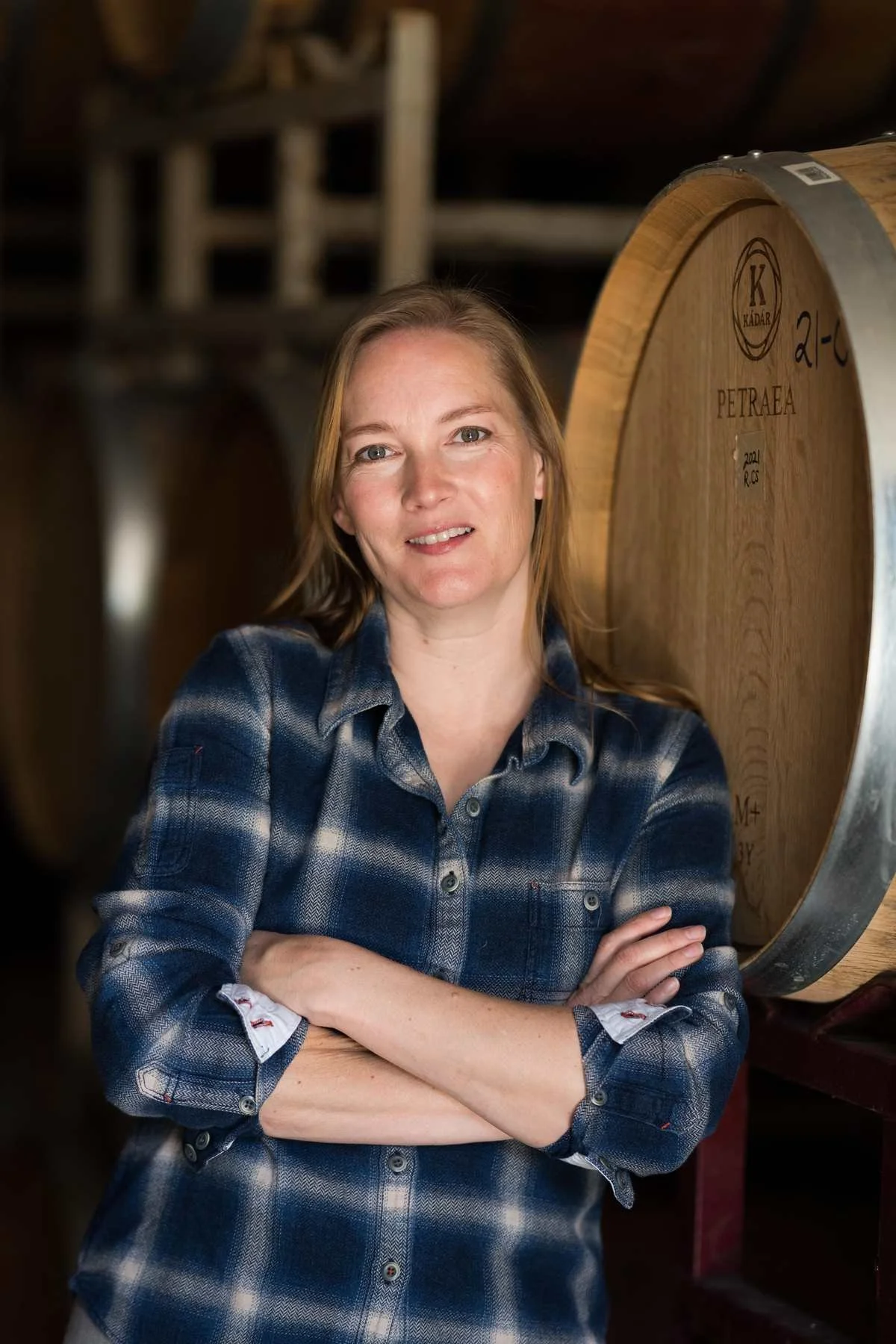
Meredith Saboraria - Livermore Valley and Valle de Guadalupe
This episode features Livermore Valley winemaker and consultant Meredith Saboraria for a wide-ranging conversation recorded on location in the heart of the appellation. A proud self-described "Livermoron," Meredith traces her path from tasting room work in the late 1990s to earning her Viticulture and Enology degree at Las Positas College and building her consulting business, Barrel Down Wine Services. Along the way, she paints a vivid portrait of Livermore's wine country — from the outsized influence of Wente and Measure D on land preservation, to the region's sandy loam soils, marine-influenced climate, and its newly adopted signature varietals: Cabernet Franc and Sauvignon Blanc. She also shares candid insights into the valley's growing community of female winemakers and the collective they've built to support one another.
The conversation then shifts to winemaking craft, with Meredith diving deep on the challenges of working with high-acid Barbera, her philosophy of balance over manipulation, techniques for punch-downs in macro bins and T-bins, and the smart use of enzymes during fermentation. Jim and Meredith also preview an upcoming Inside Winemaking group trip to Valle de Guadalupe, Baja California — Mexico's oldest New World wine region — where Meredith has traveled three times and serves as the group's guide. She covers everything from crossing the border by shuttle to the region's savory, marine-influenced wines, its world-class restaurants, and the exciting mix of traditional and modern winemaking happening in the valley. The episode closes with Meredith sharing the childhood smells of Livermore that still bring her home.
Resources from this Episode
This podcast is sponsored by InnoVint.
Wineries of all sizes rely on InnoVint’s winery operating system to optimize vineyard tracking, manage wine production processes, automate compliance reporting, track costs seamlessly, and make data-driven decisions.
The best part? The software is intuitive, easy to use, and mobile and offline friendly! And with the highest-rated customer service in the industry, you’re guaranteed to have a smooth transition, even right before harvest.
Learn more: innovint.us
Get a demo: innovint.us/request-a-demo/
Join our free winemaking community: innovint.us/join-the-punchdown/
Check out the Fundamentals of Winemaking Made Easy video course
-
Episode 216: Meredith Saboraria Podcast: Inside Winemaking
Host: Jim Duane
Guest: Meredith Saboraria Recorded: April 29, 2026
Jim Duane:
Meredith, this has been a great day for me, and I have you to thank for that. I've learned a little bit about Livermore. I've had a couple of winemakers from Livermore on in the past, but to be here, to go around to different wineries and to have you as the guide — it has been fantastic. So welcome to the show. Thank you very much. I appreciate you giving your time.
Meredith Saboraria:
No problem. My pleasure. It was really fun for me too.
Jim Duane:
Set the stage for people who aren't familiar with you — let us know how you got into winemaking in Livermore.
Meredith Saboraria:
All right. Well, I'm a Livermoron — which is a proud Livermoron. That's how you tell the transplants from the locals. The ones who are offended by that term are the transplants.
I was pretty much born here and grew up here. I spent most of my life here, and I wasn't supposed to be in wine at all. I was raised Mormon, but my parents were converts to the religion, and I always knew somewhere in my mom's past that she was a partier. So wine wasn't entirely absent from my life — I got sips at parties here and there growing up.
I really didn't know what I wanted to be when I grew up. It changed every year. I was in high school having fun, being introduced to alcohol and, you know, all the other naughty stuff, realizing it wasn't going to send me to hell. A lot of my friends were graduating a year ahead of me and going straight into working for the wine industry around here — back then, that usually meant Wente. I saw how much fun they were having, and I kind of wanted to follow. So after I graduated and spent about a year in Santa Cruz, I was forced to come back kicking and screaming, and started working in tasting rooms around the Livermore Valley. That's pretty much how I got started.
Jim Duane:
Livermore seems to be unique. I don't know any other wine region that has one really dominant producer. And you're not representing Wente today — but can you describe how much of a player they are in this pretty small valley? You said it's about 2,000 acres under vine?
Meredith Saboraria:
It's roughly about 2,000 acres right now, although things are a little different now. This is a great opportunity to start pulling stuff out and replanting, and that is definitely happening around here.
I would say it's more Wente and Concannon, although Concannon was a little less of a player, at least in my experience, for newer wineries getting started. Pre-Prohibition, we were at about five wineries. Then post-Prohibition, it came down to Wente and Concannon. Around the '70s, it started to pick up again. But when I started in the industry in the late '90s, there were still only about 12 to 15 wineries in town. Now we're back to about 50. I've seen it grow a lot, and Wente has really had a hand in that. They offer farming services for the vineyards, and they offer lab testing for the other wineries.
Jim Duane:
That's unusual — that a producer would offer laboratory services to others. That's super cool.
Meredith Saboraria:
Yeah. So back in the early '90s, they passed Measure D, which allowed the South Livermore Area Plan to become a reality. It was geared toward boosting the wine industry and the vineyard acreage here. What it created was what's called vineyard estates — any person who wanted to buy a block could buy 20 acres. Two of those acres were allowed for a house, and the rest was to be agricultural. For the first few years, it had to be grapes. After that, you could plant something else if you wanted to, but it was meant to stay agricultural. Wente was very instrumental in getting that passed.
Around 2008 or 2009, I was tapped to be on the board of Friends of Open Space and Vineyards. They were kind of the watchdogs of Measure D and the South Livermore Area Plan. There's always been somebody looking out for protecting the green space in the valley.
If you came in on 580, you may have noticed that on the north side of the freeway it's mostly open space and pasture land — some vineyards, a few houses, Las Positas College. Beyond that, there's really not a lot of development, and that's largely due to Measure D and the groups watching out for preserving open space. Wente has definitely been instrumental in that.
Jim Duane:
So tell me what Livermore winemaking looks and feels like beyond the Wentes and Concannons — the big players. Well, 2026.
Meredith Saboraria:
Yes — that definitely adds a spin to it. As many people know, there's been a pretty significant downturn in the wine industry in the last few years. But beyond that, I would say it's probably around 80 to 90 percent small wineries here — family wineries, owner-winemaker operations producing maybe 3,000 cases a year or fewer. The ones we visited today produce a little more than that.
Jim Duane:
3,000 cases?
Meredith Saboraria:
Sorry, yes — 3,000 cases. The winery we're sitting in right now produces about 1,000 cases a year.
Jim Duane:
And you called it RM — please, tell us more.
Meredith Saboraria:
Rodrigue Molineaux Winery. They've always been very small and boutique, and they have no intention of growing past that. A lot of it has to do with the high cost of owning a vineyard and a winery. People don't realize just how expensive it is getting in. So you take your small amount of revenue every year and you put it back into the winery — maybe get a new piece of equipment next year. That's just the reality.
Jim Duane:
And then what was your path into production winemaking and vineyards?
Meredith Saboraria:
I started out in tasting rooms, and then I had sort of a champion. Her name is Dale von Bowen. She's since passed away, but I worked for her at her tasting room at Stony Ridge here in town. She was in her late 30s or early 40s at the time — the only female winemaker I had ever met. She used to ask me all the time, "Why don't you become a winemaker?" And I'd kind of brush it off. I was in my early 20s, thinking that was way out of reach.
But the more she encouraged me, and the more I talked to other winemakers in the area, the more I thought — okay, maybe I do have a path there. I really didn't see myself going to university. I was raised in a lower-middle-class family, and there were high hopes for me getting a scholarship, but that wasn't really where my head was. Part of that was because I just didn't know what I wanted to do with my life.
Nobody sat me down and said, "It's okay if you choose a major and a career — you can always change it later." In my naive teenage brain, I thought if I chose a career path, that was it forever. So I'd been to community college and earned an associate's degree in geology. I always had Dale's voice in the back of my mind telling me I could do it. Less than a year after I got that degree, I opened the paper and saw that Las Positas College was about to launch a Viticulture and Enology program. I said to myself, "All right — that's it. I'm going back to school."
Jim Duane:
Did you go back full time, or were you working during the program?
Meredith Saboraria:
I was working, because they didn't offer full-time — it was mostly night classes. I took all the classes I could every semester, usually two to three per semester. I was working for Sprint at the time, in sales, which was really fun, but I knew it wasn't what I was going to do for the rest of my life — and my bosses knew it too.
One day after working there for seven years, they said they were going to lay people off. I was vested, so I had the option to take a severance package. That was a no-brainer. I got a few months of severance and a chance to really focus on the next step in my wine career.
Jim Duane:
And did you have the idea that you wanted to stay in Livermore and make wine here?
Meredith Saboraria:
At the time, yes. Partly because my family was here, and partly because the region was just starting its second boom — more in the mid-to-late 2000s. This was around 2007 when I started moving into production, and I could see there was opportunity here. People were setting up shop and potentially needed employees or winemakers. It seemed like a good place to stay. Plus, I had also started dating my husband. So that was another big factor.
Jim Duane:
I haven't mentioned this yet for the listeners, but you are the person who helped me build this trip to Valle de Guadalupe in Mexico. We're going to get to that — but first, I still want to understand what winemaking looks like in Livermore. I had a great podcast with Steven Maris who started to paint that picture. I always like to know what the main grape of a place is. And I know the look I get when I ask that, because people don't want to oversimplify — but in some sense, the market forces a region to be known for one grape or a style. Where do you think Livermore fits into that?
Meredith Saboraria:
So I'm one of those people who would always tell everyone that we grow everything really well here — and I still believe that to a large extent. But it's not really marketable, mainly because it's hard to believe.
I might get a little competitive with Napa here, but we had people telling us for years that Napa is where grapes should be grown and Livermore is too hot. There were some people who took that on as a kind of research project, even as a master's thesis, to study whether that was actually true. Because yes, we get a certain number of 100-plus degree days here every year, but it wasn't really anything more extreme than the Napa Valley floor. UC Davis has been involved in some of those studies, and the consensus was — no, this is actually a really great region to grow wine grapes, not just climate-wise, but also in terms of soil and topography.
Jim Duane:
Could you talk a little more about the soil and the geology?
Meredith Saboraria:
Sure. The soil here is mainly sandy loam — we have a lot of ancient riverbed, so sandy loam from that, and in some areas a mix of loamy clay. If it's going to be muddy, it'll stick to your shoe. But overall we get fairly good drainage, especially on hillsides and in old riverbed areas. If you get the clay mix, that means it'll hold water a little better — maybe you're a bit more selective with your rootstock, but you're not going to need to irrigate heavily. So it works well.
Jim Duane:
I've even seen a couple of dry-farmed vineyards as we've been driving around today.
Meredith Saboraria:
Yeah. And in terms of topography, where we're located in California, we get marine influence coming in over the Dublin Grade. You'll definitely see the marine layer during late summer and early fall — I'll be driving into work for harvest and it's totally overcast. We're usually the last in the Bay Area to get it, and the first for it to recede. It bumps into the Altamont and then starts going back toward the bay. That gives us enough heat and sun exposure, and then at night you get temperature swings — sometimes 30 degrees or more from daytime to nighttime. That gives the vines a break and lets the grapes cool down.
Jim Duane:
How far are we due east of San Francisco Bay?
Meredith Saboraria:
Without traffic, it's about a 45-minute drive from San Francisco — so roughly 30 miles east.
Jim Duane:
And if you went due west from here, where would that put you?
Meredith Saboraria:
Just about in line with San Francisco, I think — maybe just above it.
Jim Duane:
Grapes. I know there's been a lot of talk about Cabernet Franc — the ones I've tasted from here are really beautiful, with great varietal character. Is there a consensus that that's the red grape of the area, or is it just a smaller group championing it?
Meredith Saboraria:
I didn't go to the meetings where they made the decision, but from what I heard, there were some contentions. Some people didn't think they should choose one varietal at all. But again, from a marketing standpoint, that's a hard sell. When people want to come to a region, they want to know what's good there — why should I come, what should I be looking for?
So the majority landed on Cab Franc, and Sauvignon Blanc was also adopted — one white and one red. And I'm totally in agreement with both of those choices. I'm especially excited about Cab Franc because that's what I'm making. I don't currently make Sauvignon Blanc — I used to — but if that opportunity comes back around, I'd welcome it. I really love what it does here.
Jim Duane:
We were talking earlier about geography, and this is more about sales and tourism than viticulture, but Livermore seems to be in this unique situation — you're close enough to the major population centers that it feels more like a day-trip wine region than a weekend destination. Would you agree that right now the area skews more toward agriculture and the winery itself, and less toward tourism?
Meredith Saboraria:
Not by our choice, but at the moment — yes. We are making strides toward becoming more of a weekend destination. Downtown Livermore is currently in the works for a hotel, which would be really significant.
Jim Duane:
A hotel?
Meredith Saboraria:
Yes. Looking at something around 125 to 150 rooms — not enormous, but enough to accommodate travelers who want to do some wine tasting and wine experiences. We also have one existing wine country hotel, the Purple Orchid, which is a great boutique property, but it doesn't have the capacity to accommodate everyone. We need more rooms. The downtown is ready — great shops, restaurants, places to get a drink. The wine country is ready. We just need somewhere to put people that's not along the freeway. That hotel is in the works and coming very soon.
Jim Duane:
Let people know about your current work — what you're doing with consulting these days.
Meredith Saboraria:
I started my business in 2015 — Barrel Down Wine Services. I currently consult for three different wineries in town, though I do much more work for one than the other two. I'm always open to more clients. I also love the sommelier side of the wine world, so I offer tasting seminars as well. I even dabbled in travel advising for a while, and I want to get back into it — if there's enough interest, I have no problem going back. Competition judging is also a big part of what I do every year. Anywhere I can be involved in the wine industry, I want to be.
Jim Duane:
Do you consider yourself a specialist in any particular varieties, or have you been pigeonholed that way?
Meredith Saboraria:
I don't feel that way. A big part of that is because when I started as a cellar worker, we were making 30 different varietals at a time — everything you can think of except Italians, which I now have eight years of experience making. Spanish, Portuguese, French — all kinds. It was really a trial by fire, so nothing scares me now. I feel like I can make just about any varietal, and I like to see what it shows me the first time I work with it. I try not to manipulate too much — just get balance and really let the varietal shine.
Jim Duane:
We talked a lot today about Barbera. Tell me why you like it.
Meredith Saboraria:
I was actually very surprised at how well it sells to the public. I had never had a Barbera from Livermore before, and when I came to Rodrigue Molineaux, they grow it here and have been for many years. I was not prepared for the high acid that Barbera has. I had worked a lot with Lodi fruit before, so I was used to really low acids and how to deal with that. It's been interesting over the years to use different techniques to bring it into balance.
Jim Duane:
You can manipulate acidity with potassium carbonate and tools like that — what other approaches have you found useful for mitigating that strong acid?
Meredith Saboraria:
I think just keeping it in a cooler cellar helps drop out some of the tartrates — one of my main concerns is how much tartrate ends up in the bottle. I've tried blending it right up to the varietal limit with other wines to help bring the acid more into balance. I've also tried letting the grapes hang longer and just managing the higher Brix. And I tried using new American oak on it for a while, because I found that it seemed to smooth out the acidity without making it taste too oaky.
Jim Duane:
American oak on Barbera — I would think that would read really heavily?
Meredith Saboraria:
Maybe, and maybe I just had blinders on — but I don't do that anymore. I use French oak now. I think it might have been the vanillin in the American oak that smoothed things out a bit, but it seemed to help at the time. I don't have American oak in the cellar anymore anyway, because the varietals I'm working with now don't really call for it.
Jim Duane:
We had the Il Segreto today — that was a fantastic blend. Mostly Barbera and Cabernet Sauvignon, with a little Sangiovese, right?
Meredith Saboraria:
Yes, that's right.
Jim Duane:
How well do you think Barbera plays as a blender? Because from what I know of the grape, it has a pretty unique, lean profile that can be hard to integrate without getting dominated by a more powerful variety.
Meredith Saboraria:
One thing I love about Barbera is that it is the definition of red to me. I smell red, I taste red. I've called it the Red Queen before. Because of that acid, the color pops, all those red berry aromas pop, you get a nice long finish — cherries, berries. When I look back at my notes, I actually use it in a surprising number of blends, even when I'm doing varietal bottlings, because I rarely bottle 100% of anything.
Sometimes it's just 1% Barbera, or maybe 1.5% or 2% at most — because after that you really start noticing the acid. But just a tiny bit really lifts a wine that might be more black fruit, char, and earth-heavy. It gives it that touch of brightness. I think it's a great blender at very small amounts.
Jim Duane:
Do you feel like you have a winemaking style — something you're known for?
Meredith Saboraria:
I don't know if I'm known for it, but Livermore reds usually come in fairly acidic. It's really hard for us to get a pH above 3.8 at intake — that seems very rare. I know everyone says their style is balance, but really, I'm trying to make something I would drink a lot of. I'm not thinking about food pairings when I'm making it. I'm thinking: is this something I want to drink a glass of just hanging out — sitting on the porch with friends, just pouring it out of the bottle and wanting more?
So I'm really looking for texture from the mid-palate through the finish. I'm looking for fruit and a little bit of body. Beyond that, it is what it is, and I'm usually happy with how it evolves in the bottle.
Jim Duane:
Are there producers in Livermore who are making very big, ripe, rich wines? I haven't tasted those today, but are there people intentionally pushing the limits of ripeness?
Meredith Saboraria:
I don't know if there's anyone doing that specifically. There are people getting really good extraction, but I'm not seeing anyone picking at 28 Brix or higher — 27 is even really high around here. I think people are more focused on using things like enzymes and heat to extract as much as they can from the skins. Wente is one of those wineries that adopted wine X-ray testing and uses it a lot during fermentation. They've been talking to other winemakers about the benefits. And McGrail is another — they're using high-quality enzymes and not sulfuring heavily at crush, which allows those enzymes to work on the tannins, polyphenols, and pigments. That's where you end up with a pretty bold wine.
Jim Duane:
That's a good point. A lot of people use enzymes at crush and also use sulfur — and they're either not reading the instructions or not talking to their sales reps. Sulfur inhibits the enzymes. Dumping them in together — you're just throwing money away.
Meredith Saboraria:
Right. Before non-Saccharomyces yeasts came along for bioprotection, I was always taught to add enzymes at the crusher and then add the sulfur last thing before leaving for the day — and I'd just sit there crossing my fingers hoping it was enough. Because if you don't add any SO2 or bioprotective agent, you worry about spoilage and oxidation.
I'm really happy about the products that have come along where you don't need SO2 but you're still getting that bioprotection. The wineries using pump-overs and temperature-controlled fermentations are the ones getting the biggest body and extraction from the skins.
Jim Duane:
Do you have a preference for open or closed top tanks for the wines you're making?
Meredith Saboraria:
I would love to do more closed-tank fermentation, but the wineries I work with are so small they don't have the budget for it. So I mostly do open-top macro-bin ferments. I also use a Pulsair.
Jim Duane:
In the macro bins?
Meredith Saboraria:
Yeah. It's basically a long stainless steel tube that you attach and insert. You can't really use it in place of punch-downs — even though we'd love to think we can — but it's great for aerating, blowing off any hydrogen sulfide during fermentation, and feeding the yeast with oxygen.
Jim Duane:
I'd worry about splashing and making a mess when you pulse that air.
Meredith Saboraria:
Sometimes you do get that. It's more likely to happen in a half-ton bin than a T-bin. I cover them with plastic sheeting, which helps contain most of it, but some does get out.
Jim Duane:
A T-bin holds a ton, so you've got a higher wall and a thicker cap going on.
Meredith Saboraria:
Exactly — you don't get quite as much splashing. And you can dial in the Pulsair — adjust the pressure, the speed, the interval between pulses.
Jim Duane:
Is that something you'd be excited about on bigger tanks if you moved up to that scale?
Meredith Saboraria:
Oh yeah. I've watched videos on YouTube of people doing it on these huge open tanks — within like 10 minutes, it's all been mixed together. And sometimes just keeping the tool in place long enough creates almost a whirlpool effect where the cap starts falling in on itself and mixing up. It's pretty cool.
Jim Duane:
It is a big deal, because people who haven't run their own large commercial fermentations don't understand — when you have a cap that's three feet thick or more, you are not punching that down by hand. Especially at peak fermentation with peak CO2 evolution. It can be very hard to push through.
Meredith Saboraria:
The first time I fermented in a T-bin here at Rodrigue Molineaux, the owner warned me the cap was going to be super thick. But space-wise it made sense, and they trap more heat, so I use them whenever I can. The first year, I tried to punch down through the cap like a dummy — just using body weight and strength. I think I only recently got over the shoulder issues from that. I will never do that again.
But here's a tip: if you ferment in T-bins, dig a hole in the cap first with your hands. That's where you start the punch-down. Once you can get the tool through, you can chip away at the wall of grape skins from the inside out. A lot easier.
Jim Duane:
I have a couple of four-ton fermenters, and with Cabernet at peak fermentation I can walk right across the cap. Walk to the middle, put my feet together, and slowly sink in — but you need that initial soft spot first. Then you build bigger and bigger concentric circles to get the whole punch-down done.
Meredith Saboraria:
Yep, exactly.
Jim Duane:
So we had one Pinot Noir today. How much Pinot — and cool-climate varieties in general — is being produced in the area? There's obviously a lot of Chardonnay and a huge history with the Wente clone, but for the cool-climate reds, is that kind of fringe?
Meredith Saboraria:
I think it's a little fringe. That's one where I'll admit Livermore proper might not be ideally suited. We talked about Sunol earlier — that little 900-person hamlet just south of us. They're on the west side of 680, so they don't get quite as hot as we do. There's more tree cover there, more shade. I think if anywhere in the Livermore Valley is suitable for Pinot Noir, Sunol might be it. I've made Pinot since 2007 and I always thought it turned out pretty good — but it could be better. It is better from other areas. I'll concede that.
Jim Duane:
No degrading it here, just being honest. You go to Santa Cruz — not too far — or Sonoma and Carneros, there's plenty of world-class Pinot.
Meredith Saboraria:
Right. I think you really need a bit more marine influence for varietals like that.
Jim Duane:
Anything else that's important for people to understand about Livermore before we make the hard turn into Mexico and Valle de Guadalupe?
Meredith Saboraria:
One thing we didn't really touch on today is the number of female winemakers here. We have a pretty high percentage — somewhere around 14 to 15 percent of the winemakers and assistant winemakers here are women. Compared to the rest of California, that's relatively high, and it could actually be even more than that.
A number of years ago we started a collective, and it's been really great to have a group of female wine industry leaders — not just winemakers, but owners, management, women in restaurant and catering, growers. It's been valuable to have that group to bounce ideas off of. Because sometimes when you're in a group that's mostly men, you can feel subconsciously like you have something to prove. It's not intentional — it just kind of happens. So it's nice to have a group where you can really let your guard down and know you're going to be supported.
We do a number of events every year — usually one in March for Women's History Month, and a harvest preview called Hints of Harvest in August, where we each pour two of our favorite wines we make. It's a great reason to come to Livermore and see what the women here are doing.
Jim Duane:
A quiet shout-out to Rosie Fierro, who came down with me on the Mendoza trip in February. She owns and operates Rosa Fierro Cellars here in Livermore.
Meredith Saboraria:
My bestie.
Jim Duane:
Okay, so we're going to talk about Valle de Guadalupe. Quick note — there are still a couple of spots available on this trip, February 22 to 28, 2027. I'm learning about Valle de Guadalupe, but you've been there three or four times. Help me understand what to expect. I've seen the photos and the websites — what is the actual vibe there?
Meredith Saboraria:
So if you've ever been to a resort town in Mexico, you kind of get it already. You'll be driving down the road, look one direction — farmhouses, stray dogs, the real Mexico. Look the other direction — a multi-million dollar, very modern winery, something you might find in Napa. It's a huge juxtaposition. Every time I go, I'm still amazed. The lodging, the restaurants, the wineries — it just never ends. It almost gives me Joshua Tree vibes.
Jim Duane:
That integration of architecture with the surroundings — kind of desert-y.
Meredith Saboraria:
Yeah. Without the Joshua trees, but it is part of the Sonoran Desert. There aren't a lot of trees, but the hills are dotted with rock outcroppings that remind me a little bit of the Napa-Sonoma foothills. And there's not a ton of cactus either. They still have a decent marine influence because the valley is east-west oriented, similar to what we have here.
Jim Duane:
What — 10 to 20 miles from the Pacific?
Meredith Saboraria:
Something like that. It takes about 20 to 25 minutes to drive from Ensenada to Valle de Guadalupe. So even though they do get drier than we do, they still have a lot of marine influence for part of the year.
Jim Duane:
Until recently, I hadn't figured out how to actually get into Mexico from this side — I didn't know how to cross the border.
Meredith Saboraria:
Right.
Jim Duane:
I don't think Ensenada has a major airport. Do most people enter through San Diego?
Meredith Saboraria:
It depends on your flights. There is a Tijuana airport, so if you can get on one of those flights, you're landing on Mexican soil. But the options are limited. If you can't catch one of those, I'd highly recommend flying into San Diego. And now with CBX — Cross Border Express — it's a lot faster to cross on foot. There are a couple of entry points where you can walk across.
It's fairly easy to get into Mexico, not quite as easy to get out. I've done it a couple of times where you walk across and you come out in Tijuana and it's just total culture shock — people immediately trying to sell you tacos, get you a cab. It's a lot to take in. That's why I like to have a driver pre-hired if I do a foot crossing. But these days my preference is to go by shuttle. It's more money, but it's so nice to be picked up at the San Diego airport and driven right through.
Jim Duane:
Just two hours, done.
Meredith Saboraria:
Yeah. And coming back through into the US — especially if the shuttle has a SENTRI pass — you often don't even need to get out of the car. Shuttle operators are usually waved through because customs knows the company. You show your passport and you're on your way. If you cross on foot without any clearance, you could find yourself in a very long line.
Jim Duane:
Okay, so we're doing the shuttle.
Meredith Saboraria:
Yes. Definitely worth it. Big time saver, big worry saver.
Jim Duane:
So for my trip in February, we're doing four nights in Valle de Guadalupe itself, and then a couple of nights in Ensenada. Tell me why you like going to Ensenada.
Meredith Saboraria:
Ensenada is not the way your mother remembers it. I almost mean that literally — in the late '90s, my parents went there for their 25th anniversary cruise, and they came back complaining about it. Yes, it is a cruise ship destination, and there are things to do for cruise crowds. But there are also some really, really exceptional restaurants there.
Jim Duane:
That's what I'm most excited about.
Meredith Saboraria:
The food in that whole area is just amazing, and not that expensive. When I was there, my friend and I had the most fun, spontaneous time — we went in for a tequila tasting, ended up hanging out and dancing with this guy who was our bartender, getting tacos at two in the morning. But there's also beaches, horseback riding, amusement parks, hiking. It's just a fun little town.
Jim Duane:
What should we expect about the wine and quality in Valle de Guadalupe?
Meredith Saboraria:
The quality varies. But because I've been there so much and tasted so many different wines and talked to so many different people, I have hand-picked every winery you guys are going to. I'm not going to send you somewhere where I didn't like the wine. As a winemaker, that's what matters most to me. An impressive tasting room is nice, but it's not going to make or break it.
I will say there's a salinity factor. A lot of the wines have a kind of savory, mineral character that I haven't seen quite so consistently across the board anywhere else. I've talked to various winemakers and tasting room staff about why, and the explanation I keep hearing is this: the valley is so dry that the vineyards rely heavily on well water for irrigation. When the marine layer comes through, it deposits salt from the ocean into the soil, and the vines suck it right up. They've been looking for ways to mitigate it, but personally it's never bothered me. And actually, just like salt on food, it can bring out different characters in the wine. There are some truly world-class winemakers down there.
Jim Duane:
You mentioned there are also a lot of female winemakers in the Valle.
Meredith Saboraria:
Yes. One of the places I'm sending you — La Chuza — has a female winemaker, actually from Napa. And at Bruma, I actually got to meet that winemaker here in Livermore. They like to use modern techniques and do more experimental things with some of their wines. Even though that region is apparently the oldest New World wine region in the world, you'll find modern winemaking techniques sitting right alongside traditional ones. It's a really interesting range to taste through. Nebbiolo and Italian varietals are a big deal there too. A lot of winemakers came over from Europe — people who really know what they're doing.
Jim Duane:
Is there some Russian influence there?
Meredith Saboraria:
Yeah, although you don't really see it in the winemaking — it's more European and especially Italian influence there. But apparently there were Russian Jewish settlers who came to that part of Mexico back in the 1800s. There's actually a café and museum you can visit that serves Russian cuisine fused with Mexican food. I haven't been, but it sounds like a fascinating place. They were fleeing persecution and ended up settling there.
Jim Duane:
Imagine going from cold Russia to warm Mexico, on dirt roads. And from what I've seen in my research, some of those roads are still unpaved.
Meredith Saboraria:
Some of them, yeah. The main arteries through the valley are paved, but the ones that branch off toward hotels, wineries, and restaurants can still be dirt. They do get rain in the winter, and we're going at the end of February, so you're probably going to encounter some mud and bumpy terrain. I always tell people — don't bring cute heels. Bring shoes you don't mind getting muddy, or that have good traction. You've dealt with worse — you almost got flooded out in Argentina.
Jim Duane:
It was fun for us, but we saw some vineyards that just got rocked by hail. I don't want to make light of that kind of disaster.
Meredith Saboraria:
Right, but you can handle a bumpy wet road. And I do want to mention — the restaurants are amazing. Some are Michelin-starred. Some of the most recognized chefs in Mexico either own or cook at restaurants there. There's no shortage of great food.
Jim Duane:
Awesome.
Meredith Saboraria:
Yeah, I'm actually a little jealous I'm not going.
Jim Duane:
Well, tell people how they can contact you. If they want to plan their own trip, I know you can help with that.
Meredith Saboraria:
If you can't get on this trip but you're interested in visiting Valle de Guadalupe, you can reach me at meredith@barreldownwine.com — that's M-E-R-E-D-I-T-H at barrel down wine dot com. I also have a website at barreldownwine.com. I'm not the best at keeping up with social media, but you can find me there too. I can definitely help you put together a plan for a great experience in that area. I've been there three times in four years, and each time it's evolved. They're really starting to get a foothold with tourism. It's exciting to see the growth every time I go.
Jim Duane:
It's going to be wild. I cannot wait. Let's land this plane. What brings you back to Livermore? What are those smells that remind you of being here as a kid?
Meredith Saboraria:
For me it's more vegetative smells. I grew up with warm summer mornings — I lived about four or five blocks from my elementary school, and they had a big grass field in the back. If my siblings or any friends who'd slept over woke up early enough, we'd all run down to the school to catch the sprinklers. It would be 6 or 7 in the morning and we'd run through them, get soaking wet, and run back home half-dried by the time we got there because it was already warm. Just that smell of a warm summer morning with wet grass really takes me right back.
The other one is star jasmine and honeysuckle. We had a huge star jasmine hedge right next to our front door growing up. On warm summer evenings — even later at night when it was still warm — that scent would just hang in the air. Anytime I smell jasmine or honeysuckle now, I'm immediately back to being a kid.
Jim Duane:
Meredith, thank you so much. Thank you for doing this podcast, and thank you for all your work setting up this trip and making Mexico possible.
Meredith Saboraria:
Of course. My pleasure. I'm glad I reached out when I did — I heard you mention Valle de Guadalupe and thought, he's going to need someone to guide him. I better call him.