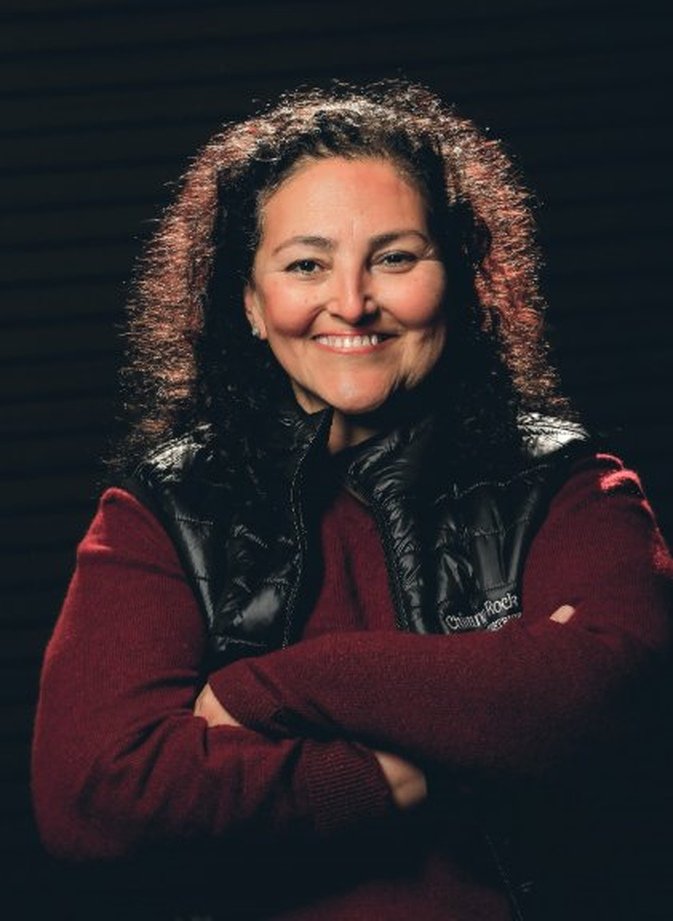
Elizabeth Vianna - Chimney Rock Winery
In this episode Jim Duane sits down with Elizabeth Vianna to explore her unconventional path from pre-med student to one of Napa Valley’s most respected Cabernet Sauvignon producers. Elizabeth shares how a late discovery of wine in New York City led her to University of California, Davis, and ultimately to a long-term career rooted in estate winemaking in the Stags Leap District. The conversation dives into the evolution of Chimney Rock’s vineyard and winemaking philosophy, including its commitment to 100% estate fruit, the use of exclusively free-run wine, and the influence of site diversity on wine style.
The episode also goes deep on practical winemaking decisions, from extended maceration strategies and tannin management to sulfur timing, racking protocols, and blending philosophy. Elizabeth discusses her increasing focus on regenerative farming, vine health, and long-term sustainability in the face of climate change, as well as her approach to working with alternative white varieties like Sauvignon Gris and Fiano. Along the way, she reflects on mentorship, leadership, and the importance of helping the next generation of winemakers develop their own instincts—making this episode both technically insightful and personally grounded.
Resources from this Episode
This podcast is sponsored by InnoVint.
Wineries of all sizes rely on InnoVint’s winery operating system to optimize vineyard tracking, manage wine production processes, automate compliance reporting, track costs seamlessly, and make data-driven decisions.
The best part? The software is intuitive, easy to use, and mobile and offline friendly! And with the highest-rated customer service in the industry, you’re guaranteed to have a smooth transition, even right before harvest.
Learn more: innovint.us
Get a demo: innovint.us/request-a-demo/
Join our free winemaking community: innovint.us/join-the-punchdown/
Check out the Fundamentals of Winemaking Made Easy video course
-
Episode 215: Elizabeth Vianna on Chimney Rock Winery
Podcast: Inside Winemaking
Host: Jim Duane
Guest: Elizabeth Vianna
Recorded: March 31, 2026Jim Duane:
Elizabeth, I’ve driven by this winery—I’m not going to do the math—but it’s got to be thousands of times over my last 20-plus years of work. It’s my first time actually being here. I appreciate you having me. How’s it going?Elizabeth Vianna:
It’s great. If I had a penny for every time somebody tells me that—it’s so funny, because we’ve been here for a long time, and the winery is still visible from the road. You can’t not look. So I’m glad we got you here, Jim.Jim Duane:
Okay, so take me back. I made you stop telling me your story earlier, but tell me about your path into winemaking and then to Chimney Rock.Elizabeth Vianna:
Yeah, so I had a long path to wine. I was actually born in Brazil. My dad was a chemical engineer, and his career took him back and forth between Brazil and the U.S. So we lived around the U.S., but primarily between the East Coast and Brazil—Boston, New York, and Brazil.I moved back permanently when I was 16 and went to college at Vassar. I was pre-med and planning to go to med school. I knew exactly what I wanted to do—I wanted to be a pediatric oncologist.
After graduating, I got a job at a hospital in New York City. My plan was to work for a bit before applying to med school and taking on all those student loans. During that time, I sort of caught the wine bug.
It’s not hard to imagine why—New York is such a great food and wine town. I had a friend whose dad had collected Bordeaux in the ‘70s, and I got to try some incredible bottles. That led to reading, tastings, and eventually I heard about UC Davis’s master’s program. On a crazy whim, I did a complete 180 and applied.
Jim Duane:
Was that a crisis of faith? What was that moment like?Elizabeth Vianna:
It was interesting. I had already delayed med school by about six years. I was enjoying New York in my 20s—doing theater, music, all of it.I think I started to feel uneasy about medicine as a path. It felt like the field was changing, and maybe it wasn’t exactly what I had envisioned.
At the time, I was working in a toxicology lab doing gas chromatography mass spectrometry. That background actually created a nice pathway into Davis. So yes, it was a bit of a crisis moment.
Some friends even staged an intervention lunch—they thought I was crazy for moving to California to become a winemaker. But when you’re in your 20s, you’re bold. Off I went to Davis.
Jim Duane:
Tell me how you ended up at Chimney Rock.Elizabeth Vianna:
Because I got into wine a little later, I knew I needed to get experience quickly. I also knew Napa Valley had a great reputation, and I wanted to make Cabernet Sauvignon—that was my grape from the beginning.I did my first internship at Trefethen in 1998, then my second at Chimney Rock. I fell in love with the property. It’s all estate-grown, about 100 acres, and that model really appealed to me.
After that, I went to Napa Wine Company, which I call my second university. There were incredible consultants there—Heidi Barrett, Celia Welch, Erin Green—and I learned a ton.
Then in 2002, a position opened up at Chimney Rock for assistant winemaker, and I came back. I’ve never left.
Jim Duane:
And Doug Fletcher had been here a long time, right?Elizabeth Vianna:
Yes, since 1987. He was instrumental in replanting the vineyard after phylloxera. He really focused on clonal diversity, matching rootstock to soil, and long-term decisions. That’s a big part of his legacy here.Jim Duane:
How would you describe the estate today?Elizabeth Vianna:
We’re about 100 acres, all estate-grown. Roughly 80% Cabernet Sauvignon, 12% Merlot, and smaller amounts of Cabernet Franc, Petit Verdot, Malbec, and a single row of Fiano.There’s great diversity—hillsides, valley floor, rocky canyon soils—so we get a range of expressions within Stags Leap District.
Jim Duane:
How would you describe the style of the wines?Elizabeth Vianna:
We’ve always been terroir-driven. Doug established a tradition of using only free-run wine, and we’ve kept that.To me, Stags Leap is about texture—finesse, polish, and softness in the tannins. That’s what we aim to capture.
Over time, I’ve reduced new oak, experimented with native fermentations, and adopted tools like optical sorting. But the goal remains the same—express the site.
Jim Duane:
What are you focused on now?Elizabeth Vianna:
Vineyard health. We became Napa Green certified and started really evaluating our farming practices.We’re focused on regenerative agriculture, soil health, and vine longevity. With climate change, disease pressure, and things like red blotch, resilience is critical.
Jim Duane:
Let’s talk extraction. Are you pushing or holding back?Elizabeth Vianna:
In Stags Leap, we don’t struggle to get extraction. We often extend maceration—30 to 35 days—and still get refined tannins.We’re also only using free-run, so that shapes the style.
Jim Duane:
What are you doing in the cellar this time of year?Elizabeth Vianna:
We’re finishing racking, preparing to bottle whites, and starting to evaluate the new vintage.We also begin thinking about blending and getting to know the wines in barrel.
Jim Duane:
How do you approach SO₂ timing?Elizabeth Vianna:
We don’t rush it. After malolactic fermentation, we often wait to allow diacetyl to metabolize away. I don’t like that buttery character in reds.Jim Duane:
What about racking?Elizabeth Vianna:
Typically every six months, but it depends on the vintage. We monitor turbidity (NTU) because we aim to bottle unfiltered when possible.Jim Duane:
Tell me about Sauvignon Gris.Elizabeth Vianna:
It’s a great blending grape for us. It retains acidity well in Napa and adds texture and volume.Compared to Sauvignon Blanc, it’s less pungent and more in the stone fruit spectrum. It’s also a great seafood wine.
Jim Duane:
And Fiano?Elizabeth Vianna:
It was originally planted after a trip to Italy. It’s very heat-resistant and retains acidity well, so I think of it as a climate-change grape.We only have one row, but it’s become a fun, small-production wine.
Jim Duane:
What about blending timing?Elizabeth Vianna:
It depends on the vintage. Cooler vintages, I tend to wait longer. I want to understand the wines before making decisions.I’m generally a purist—I prefer not to blend across vintages because I want to express the character of each year.
Jim Duane:
You take mentorship seriously. Where does that come from?Elizabeth Vianna:
From being mentored. I had incredible people who shared their knowledge with me.I believe in paying that forward. It’s not about telling people what to do—it’s about helping them ask the right questions.
Jim Duane:
What advice would you give a mentee?Elizabeth Vianna:
Be honest and ask hard questions. The goal is to help you find your own answers.Jim Duane:
Anything else you want to add?Elizabeth Vianna:
Just that I feel incredibly lucky to have this place and to farm these vineyards for so long. There are many paths in winemaking, and this has been mine.Jim Duane:
Final question—what does your childhood smell like?Elizabeth Vianna:
Coconut sunscreen. I lived in the water growing up in Brazil.Jim Duane:
That’s perfect. Thanks so much.Elizabeth Vianna:
Thank you.