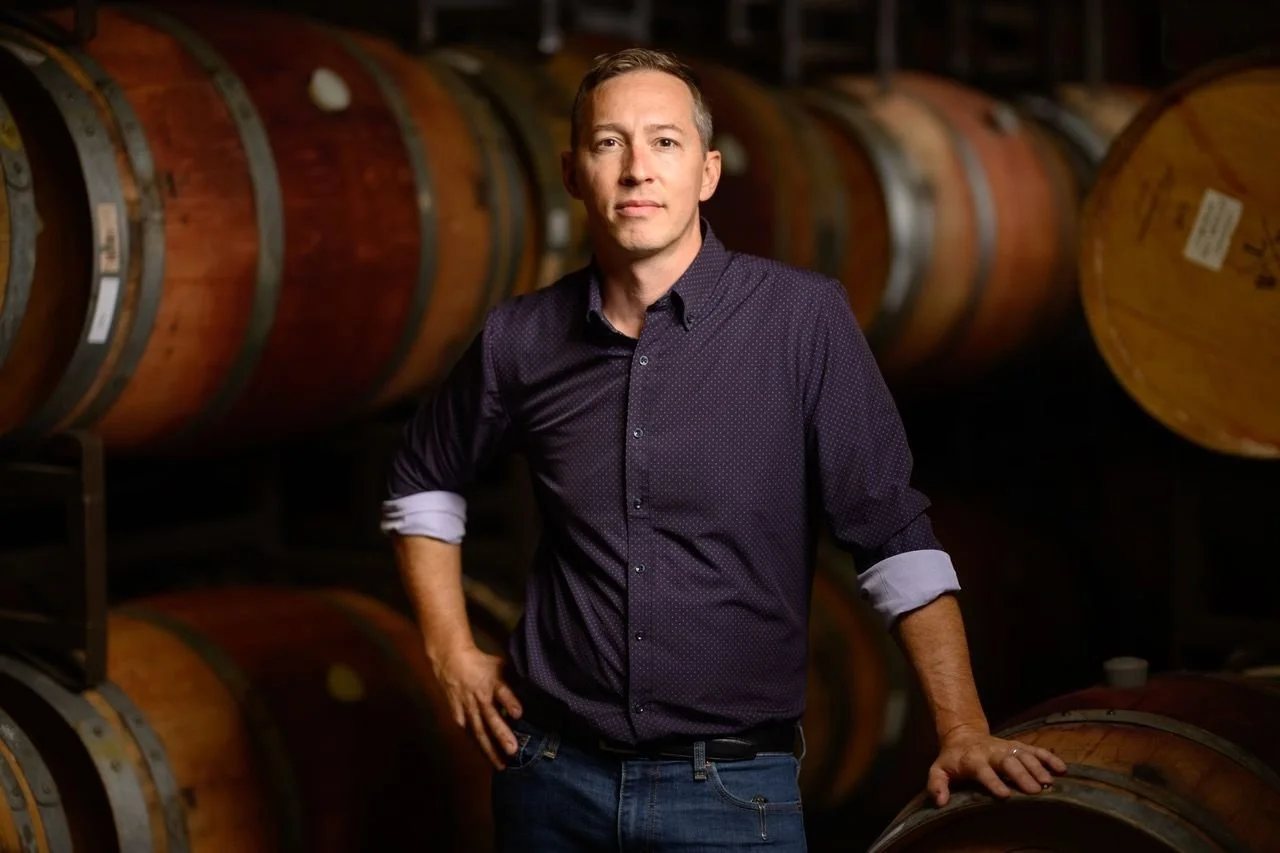
Jason Moulton - Whitehall Lane Winery
This episode features an in-depth discussion about winemaking at White Hall as the team nears the end of the 2025 harvest season. The episode begins with insights into the progression of the harvest, focusing on the completion of most varietals and the ongoing work with late-harvest selections like Semillon.
Our conversation runs the gamut of technical issues such as stabulation of Sauvignon blanc juice, cellar techniques ot avert the need for fining and filtration, and Whitehall’s trials with Pierce’s Disease resistant clones from UCDavis.
Resources from this Episode
This episode is sponsored by Harvest Pillar concrete trellis posts. Want to know why more growers are going for concrete? It’s because Harvest Pillar is the last trellis post you’ll ever need.
Check out the Fundamentals of Winemaking Made Easy video course
-
Jim Duane:
Okay, it’s pretty rare that I catch people before the end of harvest. Usually I give them the grace of being able to finish harvest before getting back into podcasting. But here we are. Can you set the stage for where you are in your harvest process for 2025?Jason Moulton:
Yeah. So it’s November 10. We’re doing some late harvest at this point. We’ve got some late harvest Semillon out there that we’re working on making. For the most part, we’re done with all our reds—we’re pressed off, barreled down, pretty comfortable. Things are looking good. Despite the early rains that swooped in, we got everything in, and I’m happy with the result.Jim Duane:
What harvest number is this for you here at Whitehall?Jason Moulton:
This is 10 vintages. Ten years, and yeah—so far, so good.Jim Duane:
Maybe you can take a minute to describe your background and where you were working before you came to Whitehall.Jason Moulton:
I’m from Illinois originally and graduated from Southern Illinois University Carbondale. I actually have two bachelor’s degrees—in Spanish and hospitality and tourism. I started out thinking I wanted to run a hotel, be interested in that whole sphere, and then I got into the Southern Illinois wine industry as a junior in college. I found out pretty quickly this is what I wanted to do.I took a microbiology class that set the tone. If you’re familiar with Semester at Sea, I did that in summer 2000 on a ship. We were in the Mediterranean and North Sea, went around nine different ports, and learned about the history of microbiology—wine making, beer making, cheese, the Black Plague, the Salem witch trials, all these things in history that affected us. Wine was part of that, and it really set me up for getting into wine.
From there, I ended up moving to Canada to enroll in a program with Okanagan University College—now University of British Columbia. It was a wine assistant winemaker certificate. I worked in Canada for a bit, but it didn’t work out long-term due to work visa issues.
Jim Duane:
Why did you go to Canada in the first place?Jason Moulton:
I was involved with the American Wine Society—the largest consumer nonprofit group focused on American wine education. I went to a conference in Buffalo, New York, and met one of the owners of Sumac Ridge Estate Winery in Summerland, British Columbia. Saw the opportunity and moved out there. It really set me on my path. I learned a lot—ice wine, the varieties in British Columbia, all of it.Jim Duane:
Where in British Columbia?Jason Moulton:
Penticton—Okanagan Valley. Beautiful place. They refer to it as Canada’s Napa.After that, I wanted more education—a postgraduate diploma in Viticulture and Enology—so I went to New Zealand, Christchurch specifically, at Lincoln University.
Along the way I worked at Korbel in the Russian River and learned sparkling wine, then moved to New Zealand.
Jim Duane:
Where were you working?Jason Moulton:
While I was in school, I did an internship at Daniel Schuster Winery in Waipara, just north of Canterbury and Christchurch.Jim Duane:
Daniel used to work as a consultant for Stag’s Wine Cellars. I met him a couple times.Jason Moulton:
Oh, fantastic. He is a character. I love him. He made me look at wines as people—characters—and how they express themselves in a glass. My favorite thing was how he’d refer to his Pinot Noirs as either Dolly Parton or Bob Dylan.He was the godfather of that movement. I think he was the first person to make Pinot Noir on the South Island.
Jim Duane:
He was kind of a long-term consultant with Warren Winiarski in the vineyard. Warren really liked him. Is Daniel still around making wine?Jason Moulton:
I’m not sure what he’s up to now—I haven’t stayed in touch. But he blew me away. He used to smoke while describing wine and I was in awe.Jim Duane:
I heard a theory once about protease inhibitors—something about smoking affecting inhibitors so you could taste more. It was a little out there, but interesting. And I mean, how many great French winemakers smoke like chimneys?Jason Moulton:
I don’t get it, but he knew something I didn’t.Jim Duane:
Were you thinking you’d live in New Zealand, or was it more of an adventure and you’d come back to the States?Jason Moulton:
Napa Valley was always kind of the target. I wanted cool-climate experience in New Zealand—Pinot, Sauvignon Blanc—and then my next step was Bordeaux. I wanted that Old World experience coupled with the New World.After Daniel Schuster, my next vintage was with Wither Hills in Marlborough. Then I moved to Graves or Sauternes—specifically a small dessert wine region near Barsac.
Jim Duane:
So you should be good at this Semillon tomorrow.Jason Moulton:
I hope so—picking berry by berry. Paying your dues.Jim Duane:
You’ve pressed botrytis wine before?Jason Moulton:
Yes. From recollection, it was a direct feed to the press in Bordeaux. Press size matters, and what bar you can get to. I’ve also spoken with people about foot-treading—Jillian over at Laffort said you have to foot-tread—so tomorrow I’ll be foot-treading Semillon.Jim Duane:
Good luck. How are you thinking about SO₂ protection, oxidation risk, laccase?Jason Moulton:
I’m trying to hit it with 40 parts total, kind of like normal white wine. But there’s a lot you have to do—go after laccase, go after protein instability. Right enzymes, bentonite early. You have to get the foreign molds out of solution—cold settle, rack clean, then ferment.Jim Duane:
What alcohol are you hoping to end at?Jason Moulton:
Somewhere between 12 and 14—maybe even 11. Depends on balance and the sugar you want to leave behind.Jim Duane:
Do you know what sugar level your grapes will come in at?Jason Moulton:
Anywhere from 28 to 33 is where I’m at. It’s hard to sample accurately. I did individual berry sampling and removed green grapes within clusters because they drop your sugar.Jim Duane:
Cool. So when did you come to California?Jason Moulton:
After Bordeaux, I went to South Africa, then back to Bordeaux. And later, American Wine Society kind of guided me again. I went to a conference in Winston-Salem and attended a Rutherford Dust Society seminar with Paul Wagner from Balzac Communications.I was 27 and had this weird experience—an omen. I tasted Long Meadow Ranch Sauvignon Blanc and Quintessa Cabernet. That night, a job popped up online for Long Meadow Ranch. I applied and got it and moved out immediately. That was 2007.
Jim Duane:
Was this the work-by-yourself at some distant facility job that Long Meadow Ranch had for a while?Jason Moulton:
No, this was being the only cellar person—cellar master—running the whole thing. I had a great consulting winemaker, Ashley Heisey. She was an incredible scientist and mentor—just layers on layers of knowledge.Also, shoutout to Julie Johnson at Tres Sabores—she was the first person to offer me housing when I arrived. I lived with her for a few months, then transitioned to a property up at the top of Whitehall Lane. Years later, I circled back and now I’m here at Whitehall Lane. Pretty awesome.
Jim Duane:
You started here in 2015?Jason Moulton:
2016. In between, I worked at Cliff Lede for a bit in Stags Leap with Kale Anderson and Philippe Melka. Then I went to Lake County to work at Brassfield Estate with David Ramey consulting.There’s so much to learn, and you’re lucky when you get time with historic figures you can learn from. I felt lucky to work with him for a couple years. Then this opportunity at Whitehall popped up in 2016 and the rest is history.
Jason Moulton:
Whitehall was established in 1979. The Finkelstein brothers started the winery. It eventually changed hands to a Japanese corporation in the late 80s/early 90s—back when Japanese companies were buying property in America.In 1993 the Leonardini family purchased the property. It’s been family-owned for about 33 years. In an era of acquisitions and private equity, it’s great to see a family owning a Napa winery for that long.
I’ve only worked for family-owned wineries my whole career. I work closely with Katie Leonardini and her brother Tom Jr., who handles distribution and national sales. On production, I have Tom Jr.’s son Tommy with me as cellar master, so it’s truly a top-to-bottom family business.
Jim Duane:
What do you own in the way of vineyards?Jason Moulton:
About 200 acres, eight properties total—six in Napa and two in Sonoma. Two in St. Helena, three in Rutherford, one in Oak Knoll, and then Petaluma Gap in Sonoma.A lot of people don’t realize the diversity. We were buying fruit up until 2021/2022, then decided to shift to becoming estate-only. We’re on that trajectory now—estate Cabernet, expanding beyond that, estate Merlot soon, our Napa Cabernet likely going estate, Sauvignon Blanc is estate—everything bundled into an estate winery program.
Jim Duane:
What is Whitehall known for?Jason Moulton:
Different people will say different things—Merlot, Sauvignon Blanc, Cabernet. We make 20 different SKUs: lots of single-vineyard Cabernets, Petite Verdot, Malbec, Merlot as a blend, Sauvignon Blanc, Semillon, Chardonnay, Pinot Noir—there’s diversity.Jim Duane:
What style of Chardonnay are you producing?Jason Moulton:
We recently developed a clone-specific Chardonnay—Dijon clone. Previously our Chardonnay was partial ML, about 35% new French oak. I don’t want it smashed with oak; I want fruit there.So now we have one that’s partial ML, and the clone-specific Chardonnay is unfiltered, single-clone, and full malolactic.
Jim Duane:
When you’re deciding where to cut off malolactic for the partial ML wine, how do you think about that?Jason Moulton:
It’s about developing an accurate trend—following malic consumption. We can track daily if we want to. You see the trend over a week and estimate where it’s headed.Cold weather can interrupt it—if the cellar gets cold you’ll see it flatline—so you have to be on it and catch the right window, tasting and knowing where you want that balance of acidity, fruit, oak, and harmony.
Jim Duane:
Are you looking for green apple malic flavor, or just acidity in general?Jason Moulton:
Acidity in general. I’m not a huge fan of buttery popcorn. We try to find malolactic bacteria strains that won’t overproduce diacetyl. It doesn’t always work, but we trial different bacteria.A lot of people taste straight out of a wine thief. I run it into the lab, centrifuge it, and then you get the true texture. You really see balance when you pull yeast out of solution.
Jim Duane:
We’ve been thinking about that lately. When I press reds, the first squeeze is filled with solids and leaves. I wonder if I’m actually tasting what I think I’m tasting, or if I’m fooling myself.Jason Moulton:
I’m with you. When you get into higher pressure and start seeing sugar come back because berries haven’t all popped, I bring it in, centrifuge it, see what we really get. I run a DMA to make press cuts.Jim Duane:
DMA meaning a densitometer—checking sugars.Jason Moulton:
Exactly. It tells you how much sweetness you have, whether it’ll finish, whether you need a different tank, whether your yeast are viable. You don’t want two grams sitting in your final blend before you barrel down.Jim Duane:
I go to barrel sweet all the time. I’ll go to barrel at 0.2 Brix or higher.Jim Duane:
You mentioned stabulation. For the benefit of people who haven’t heard it explained before, what is stabulation, how do you practice it, and why?Jason Moulton:
With our Sauvignon Blanc, we use a lot of tools—skin contact, barrel ferment, reductive vs oxidative handling. Stabulation, for me, was about enhancing mouthfeel and boosting aromatics.Stabulation is holding your pressed juice—with the lees—in a cold tank at about 35–45°F. I can press 10 tons, take all that juice to tank, and drop temperature. At the same time, I add a bioprotector—an inactive yeast product—to help protect the juice because it’s going to be cold for 10–14 days.
I add a thiol-focused enzyme—Laffort makes a great one—to boost thiol expression and get more passionfruit character while building texture. I still use sulfur—about 40 parts total—to prevent oxidation. We keep it topped, gas-protected, and it holds well.
I’ve done probably 20–30 stabulations in seven years. In any given year, maybe 30–50% of our commercial Sauvignon Blanc blend includes stabulated lots.
We mix it daily—sometimes twice. You’re getting lees and enzymes into solution, keeping it active. We did a study with Laffort, and stabulation reduces grapefruit character and pushes more boxwood and passionfruit.
Jim Duane:
So stylistically you’d want to know that going in.Jason Moulton:
Exactly. If you love grapefruit, don’t do this.Jim Duane:
If you love cat pee…Jason Moulton:
The irony is New Zealand Sauvignon Blanc—those boxwood/cat pee numbers are through the roof. We’re nowhere near that, but they’re unique.Jim Duane:
How do you know when you’re done with stabulation and it’s time to inoculate?Jason Moulton:
Fourteen days is ideal if you can hold it, but during harvest you need tanks for reds, so I settle into eight to ten days. Then we rack clean, get lees down under about 2%, and start fermentation.Jim Duane:
Any different fermentation kinetics?Jason Moulton:
No, it behaves like a normal fermentation. I worried about oxidation at first, but total sulfur holds almost the entire time—you might lose two to five parts—if you protect it with nitrogen or other inert gas.Jim Duane:
Does the bioprotector consume nitrogen so you end up with low YAN?Jason Moulton:
Good question. I run ammonias and NOPAs right before fermentation. I do think the bioprotector might move a touch—maybe half a percent alcohol—but I haven’t ended up with zeros. It’s fine.Jim Duane:
How would you describe the textural increase?Jason Moulton:
It’s silky smooth—roundness across your palate. It’s kind of the opposite of phenolic. One year I compared a cold macerated tank, a control, and stabulation. Cold maceration brought phenolics; stabulation brought silkier texture. Phenolics can be helpful, but if they dominate it can feel like a meal. As a percentage of the overall blend, it’s great.Jim Duane:
Are you doing other practices post-fermentation to build mouthfeel?Jason Moulton:
Yes. A percentage is handled oxidatively—barrel ferment, no sulfur during the day, then sulfur at the end of the day and barrel the next day. About 10–15% new French oak. I like hot barrel ferments around 76°F for another layer of texture.Stabulation texture, barrel ferment texture, cold macerated texture—it’s about layering.
Jim Duane:
When do you bottle?Jason Moulton:
Maybe March. We’re not in a rush. We have our own bottling line here, which gives us control. If glass or labels are delayed, you can push it a week.But when something goes wrong, you’re calling Italy and asking who speaks the most Italian today.
Jim Duane:
Owning your own bottling line stresses me out just thinking about it.Jason Moulton:
I’ll take you on a tour. I’ll show you the stress.Jim Duane:
You mentioned vegan and gluten-free. We get these questions all the time. What’s your thought and how does it work in your production?Jason Moulton:
This came about a couple ways. I think new consumers care about these things, and we want to welcome them into wine. Also, I have a slight gluten intolerance, and my owner’s son does too.It was a long process. I don’t use gelatin anymore. I stopped using egg whites in 2016. That first year I had one really tannic wine and I thought, “Egg whites—good lord.” Egg whites can be aggressive. Gelatin I’d only use on press wine if pressing was aggressive.
Tannin management became the key. We use Wine Xray for phenolic management. My predecessor, Deane Sylvester, was here 18 years and used it too. Knowing your phenolics during draining and pressing lets you see which lots might need fining—but also helps you avoid getting there in the first place. If catechin and seed tannins are climbing, you press sooner. Instead of thinking “I’ll fix it with fining,” I think “I need to move this around in a blend and find it a home.”
I loved casein and isinglass in whites, but I stopped using them. For whites we use bentonite for protein stability.
Gluten-free required changes starting in 2023. I required all cooperages to use buckwheat flour instead of wheat flour for barrel head sealing. Now all my barrel purchase orders specify no flour.
Is it certification? No. TTB rules are you can put it on label, but you need to be able to test if called upon. So you need analysis to back it up.
Jim Duane:
Are you sending wines out at the end of the day to establish baseline gluten levels?Jason Moulton:
In the end, I don’t have these products here anymore, but I still do due diligence and check. It’s peace of mind and the right thing to do.Jim Duane:
Years ago I got lit up because a company was telling the Paleo crowd that wineries were picking up gluten from filtration materials—wheat-based pads. I looked into it and the guy was full of it. No one’s using wheat filter pads.Jason Moulton:
Yeah. It’s important to note: our reds are unfined and unfiltered, but I only moved into vegan/gluten-free winemaking in the last two years.With an unfined wine, you really don’t want to be adding products because a filter might pull them out and you could test “clean,” but you still used them. For me it was about not adding anything and keeping reds unfiltered.
Filtration can pull aromas, color, flavor, texture—things that hold a wine together. I’m not saying filtered wine is soulless. I filter Sauvignon Blanc and it still has a soul. But reds are more complex.
Not everyone has the opportunity to go unfiltered. If you have high microbe load, you need that tool. I respect that.
Jim Duane:
I get asked all the time if I filter. I don’t, but only because I don’t need to. If I popped hot on Brett or had bacterial issues, I’d filter. I’m not dogmatic. Filtering is work, and if I don’t have to do something, I’ll cut it out.Jason Moulton:
I’m with you. I remember doing Kuno filtration years ago at Long Meadow Ranch to prep for mobile bottling. I calculated throughput and it was like, “Oh my god, this is an 18-hour filtration.” I had to come back at two or three in the morning to wrap it up. You can time it, but it’s like predicting your demise.Jim Duane:
If you’re not going to filter, you still have to change practices to avoid putting a lazy, sludgy wine in bottle. How do you think about barrel settling, racking, and bottling prep without filtration?Jason Moulton:
The NTU meter is key—measuring haze. I count my lucky stars I worked with Ashley at Long Meadow; she taught me to rack based on NTU.It tells you how hazy the wine is and whether your spacer is right, or if you’re just blindly racking. You want to improve each racking: big spacer, medium spacer, small spacer.
Jim Duane:
Spacer meaning on the end of your barrel wand?Jason Moulton:
Exactly—three-quarter inch, half inch, quarter inch. Each racking you try to do better. We track it and make sure people rack clean because we’re an unfiltered house.Jim Duane:
When you rack to tank, do you settle in tank for a couple days or go right back to barrel?Jason Moulton:
Usually right back, but it depends on the blend and logistics. If it’s a big blend, it might take a day or two to get everything through, but there isn’t intentional settling time. We’re just moving.Jim Duane:
I’m basically a one-man crew most of the year, so I rack out one day and rack back the next. Even one night in tank at 55°F gives decent settling.Jason Moulton:
I used to be more obsessive about it. Now I trust the team here to watch it and make the right move.Jim Duane:
After your final pump-out to tank for bottling, how long are you in tank settling, and do you rack tank-to-tank prior to bottling?Jason Moulton:
Usually a week to two weeks in tank prior to bottling. We bring it up, make sure sulfur is good, everything squared away. We’re generally pretty clean at that point because we’re already down to the small spacer. But it depends. You watch the first barrels, see what’s happening.Winemaking is sensory. You need eyes on it—did you rack clean, or did you blow it? You can’t make assumptions.
Jim Duane:
Tell me about Carignane Noir—am I saying that right?Jason Moulton:
It’s Caminare Noir and Passe Noir. Two Pierce’s disease–resistant varieties we grow. We had a great relationship with UC Davis—previously with Dr. Andy Walker—and our viticulture consultant Dr. Paul Skinner.Paul had the opportunity to get cuttings and plant them around 2016 on what we call “the island,” our vineyard in Oak Knoll that was getting decimated by Pierce’s. They kept replanting Sauvignon Blanc, and it’s a nightmare. The island is a sliver of land off an offshoot of the Napa River—it floods in big rains.
These two varieties were planted side by side. Dr. Walker worked over 20 years on the project, crossing with Vitis arizonica.
Jim Duane:
I worked with Walker when I first came out—doing some field work caring for these plants. You mentioned Ashley Heisey—her husband Alan Tensch was one of my first mentors in California.Jason Moulton:
I was going to mention Alan. Between Ashley and Alan, they were involved in this. Andy was breeding; Alan was doing fermentations and making wine from these, experimenting, tasting with the community. I went to a tasting with Alan at UC Davis where he presented all these wines—it was special.Caminare Noir is around 50% Cabernet—then Petite Sirah in its makeup. Passe Noir is Cabernet, Petite Sirah, and Zinfandel. The Zinfandel gives more red fruit.
They hold up well. What’s interesting is they keep accumulating Brix and don’t break down—they just keep trucking.
Logistically, it’s a tiny piece for us, so I pick them alongside Cabernet and bring them in on the same day as a big Cabernet pick in Oak Knoll.
One day I was tasting through a lineup of Cabernet ferments, blinding, and I hit the Passe Noir and Caminare Noir without realizing what they were. I thought, “That is the best Cabernet—what is that?” The tannin profile was expressive and special.
Then I realized: it was the new varieties. That was 2019, and I thought, these are going to make history. I told the owners we should make the first commercial bottlings in the U.S.
We tried to print labels and TTB said, “No, these are not varieties.” It was disheartening. I went to Dr. Walker and Dr. Skinner and asked them to help, and apparently there was one step that needed to happen. Then we got a letter: these are varieties, you can use them. The TTB approved it, and we bottled the first commercial bottlings in the U.S.
Jim Duane:
And now you blend the two?Jason Moulton:
I blend them now. I haven’t done single-variety bottlings in a bit. But now Texas Hill Country is all over these because of Pierce’s pressure, and Ojai is making their own too. It’s spreading slowly. Some people are blending it into other wines. In one vintage, we put it into our Moutinho Cabernet, so it’s part of one of our Cabernets.Jim Duane:
Will you plant more?Jason Moulton:
We’re kind of hovering on that. If Pierce’s starts taking down the Cabernet, these serve as a buffer zone—something to feed on while vines survive. If it intrudes into Cabernet, then I’d move into replanting with these.The most special thing is the bound tannin profile. In Wine Xray terms, the bound tannin profile on Caminare and Passe was extraordinary—through the roof. It reminded me of the Tokalon Cabernet profile.
Jim Duane:
Bound meaning anthocyanin bound to tannin?Jason Moulton:
Yeah. I refer to it as bound. It’s that mouthfeel—kind of an umami character that makes a wine big without destroying your mouth.Jim Duane:
Very cool. Anything else you want to mention before we wrap?Jason Moulton:
No, I’m good. I really appreciate the time, Jim. This was great. Thanks for having me on.Jim Duane:
You bet. You grew up in Illinois. Tell me what your childhood smelled like.Jason Moulton:
I think I saw this coming. Fun Dip by the pool. The chalky vanilla spoon, and all those flavors—cherry, grape. It’s a strong memory.Jim Duane:
Definitely a strong memory for me too.Jason Moulton:
That powdered sugar thing—kind of aggressive, but I can remember exactly where I was eating it. That’s crazy.Jim Duane:
Okay, Jason, thank you so much. It’s been fun.Jason Moulton:
All right. Thank you.