jan krupp - Krupp Brothers
In this episode, I talk with Ry Richards, winemaker at Chappellet on Pritchard Hill, about his circuito
Resources from this Episode
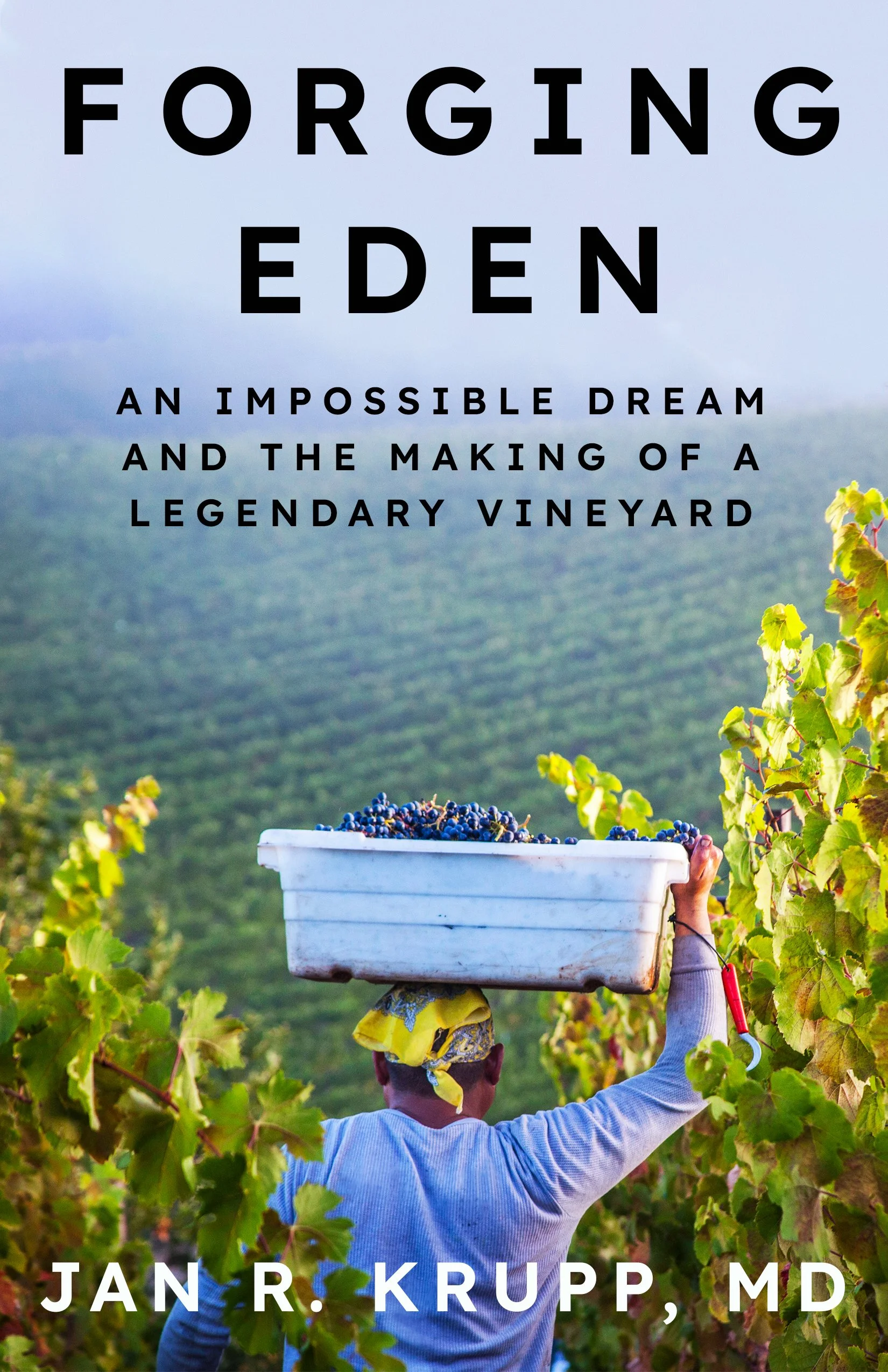
Forging Eden - An Impossible Dream and the Making of a Legendary Vineyard Jan’s book published 2026 As an Amazon Associate, I earn from qualifying purchases.
This podcast is sponsored by Wine Compliance Alliance.
Are you concerned about your winery’s reporting? Do you worry that it’s not being done correctly, or being vulnerable to a TTB audit? Help is here!
The Winery Compliance Training Academy has custom-designed courses created by industry experts with deep backgrounds working at wineries managing production compliance! Our course, The TTB reports all US Wineries are required to file is designed to walk you through the 3 reports all US wineries are required to submit to the TTB. This course is a fit for all winery staff who are responsible for filing reports or label approvals to the TTB.
Check out the Fundamentals of Winemaking Made Easy video course
-
Episode 227
Guest: Jan Krupp
Recorded: November 2026
Jim Duane:
Okay, Jan. Thank you for inviting me to your home here. As I was telling you before, I was a little bit hesitant to come up to your house, because last time I came up to your house on the vineyard up on Atlas Peak, I was almost assaulted by the dogs.
Were those German shepherds? I remember they were big. That's all I remember.
Jan Krupp:
They were a mixture. Yeah, boxer, a big mutt, a standard poodle.
Jim Duane:
Yeah. So, are you a dog guy?
Jan Krupp:
I like dogs. We have a standard poodle puppy now and an old boxer.
Jim Duane:
Okay. So maybe to set the scene here, we're going to talk a lot about your background and building Stagecoach and vineyard development. But this conversation is timely because you've just written the book Forging Eden, about your story of coming into Napa Valley and building Stagecoach and Krupp Brothers.
Can you set the scene quickly for people that don't know your background, and we'll take it from there?
Jan Krupp:
Sure, Jim. I started on the career path to become a doctor, and in between my internship and my residency, I did military service in Phoenix, and I got exposed to a lot of great wines.
My friends and I had time. As doctors working for the government, you're not overly busy, so we'd cook for each other and explore wines, California versus Europe.
In addition to that, there was a drive-up bottle shop, and the owner introduced me to some world-class wines, and they were relatively affordable. Later, I learned the reason they were so cheap was that he never paid his taxes, and he was in jail. That was one of the reasons. I guess he purchased right too.
But anyway, when I got back to Stanford for the rest of my medical training, I got to be friends with a professor who was really good at teaching me how to save people. We'd go out to dinner occasionally.
He said, "You know, Jan, I can see you really like good food and wine. How about if I teach you how to make wine better than almost anything you can buy?" So I said, "Okay, Larry, we're in."
He taught a friend of mine and me how to make wine in his garage, and it was just a lot of fun, sourcing the grapes and the barrels and trying to make really good wine. In the first few years, the wine was disappointing.
I had a colleague at the hospital who was a cardiologist who loved food and wine, and he asked if he could join our group. I said sure. When Cliff got there, he was so meticulous about cleaning that all of a sudden our wines really leapt off the map, and we would win best of show at county fairs.
I guess you, as a winemaker, Jim, know how important cleanliness is. I knew as a doctor how important it was, but I didn't know you had to apply the same standards to winemaking to make great wine.
So for 17 years, winemaking was a hobby. It was a lot of fun. Medicine was challenging, and the two kind of balanced each other. Then I got kind of tired of the medicine and was really loving the winemaking, and I decided I needed a backyard vineyard, so I started looking.
As a doctor of internal medicine, I didn't think I could afford a vineyard. My first wife encouraged that notion. I was about to give up after seeing vineyards in the Stags Leap area of Napa that needed replanting but were still 40 grand an acre.
I had a vascular surgeon willing to give me his vineyard in Healdsburg for free, just pay the taxes. He was losing so much money.
Then a radiologist who had a great vineyard in Stags Leap, Richard Chambers, told me, "You should really look at Cabernet. The economics are better." I said, "Yeah, but a vineyard in Stags Leap that has to be replanted is so much." He said, "I know, Jan, but you'll love it."
Well, I wasn't convinced I could afford it, and then one day in the Chronicle, I saw an ad for 41 acres way up on Atlas Peak. You've been there, Jim. I started hiring smart viticulturists, who thought the grapes would be great if my kids could survive the road.
Jim Duane:
That was a dangerous road. I drove that many times.
Jan Krupp:
You remember? Yeah, it's a dangerous road. So I bought it, and we found water and moved a lot of rocks.
I ended up with a second vineyard manager, not a Davis-trained guy, but the manager for Antinori's big vineyard. He kept telling me he could do it cheaper, he could do it better, and I didn't believe him because he hadn't been to school. But eventually, as I learned more, I could see he was right, so I hired him.
We had our first nine tons of Cabernet, and there was a glut of Cabernet at the time. So I knocked on 50 doors, either in person or by telephone, to sell those first nine tons of grapes. I was able to sell them to Round Hill, which has since become Rutherford Ranch, I think.
The next year there were going to be a lot more grapes, the way vineyards go. The first year, Villa Mt. Eden and Conn Creek had kind of jumped on the bandwagon, but the grapes were sold to Round Hill. So with more grapes coming online, I called those guys, and they were interested in picking up some grapes.
Then I heard that the winemaker for Stag's Leap needed more grapes, so I called him.
Jim Duane:
Who was that?
Jan Krupp:
Jim Jensen, or...
Jim Duane:
John Gibson?
Jan Krupp:
John Gibson. I'm sorry, Jim.
Jim Duane:
It's okay.
Jan Krupp:
John Gibson. So he came up, and lo and behold, he brought Warren Winiarski and Randy Pace with him. Warren really liked the block in front of my house, and he said he would be in, and I said, "That sounds good, Warren."
He said, "You know, the only thing, Jan, is I've never bought grapes from a vineyard I haven't tasted from. Even the original Fay Vineyard, where I put my winery, I tasted Nathan's grapes as a home winemaker."
I said, "Warren, I'm sorry, but all my grapes went into a blend at Round Hill. I don't have anything." He said, "Well, I'll come back next year when you have something."
Then I thought for a minute, and I said, "Wait a minute, I'm making a barrel in the basement. Why don't I go down and get you a glass?" So I got him a glass, and he tasted it, and he looked at me and said, "You know, Jan, I'm having an epiphany, just like when I tasted at Nathan Fay's vineyard. I want those grapes, and this is going to be wonderful. Let's draft a contract."
So that was the start of a really good customer, as well as the original people, and things were going pretty well. I planted more grapes on that 41 acres. I added ZD, who said, "Well, we'll buy your Cabernet if you plant some Merlot too." So I tried that.
This was getting to be so much fun, and it was really surprisingly successful. So I thought, "Well, I'd like to do more of this. I really know a lot about rocks now. Maybe not so much about grapes, but a lot about rocks. And I have a really good vineyard manager working for me part time. Maybe he'd come with me full time if I could find some more land."
So Esteban was working his job at Atlas Peak and then moonlighting for me. You know Esteban too?
Jim Duane:
Of course. Yeah, he's a fixture in the valley.
Jan Krupp:
Yeah, he really is. He had two guys, actually two relatives of his wife, who were doing most of the work. But he'd come over at lunchtime and tell them what to do and talk to me.
---
Jan Krupp:
I started to look around up there, and there wasn't anything really appealing. There was a lady who owned a lot of acres, and she said, "Come tromp through my wilderness and make me an offer." I did, and I thought maybe this could work too.
I told her what I thought it was worth, and she said, "Well, you know, Jan, I really didn't want to sell it. I just wanted to know what somebody would pay for it." So that was my first failure, and I was about to give up. There was nothing really available there.
Then one day I saw an ad on a telephone pole, and it was for 750 acres, and it was unbelievably cheap. I think it was around two and a half million, 2.8 million. I couldn't believe it.
But there were reasons it was so cheap. There was no road to get there, not even legal easements to build a road. Nobody had found water in that part of Napa, or at least significant water. Doug Hill had three small wells at Briarstone, but I wanted to do more acres than that.
So we set off on a journey to find water, to negotiate easements, to build a road, to learn how to dynamite rocks. At a certain point the owner said, "You know, Jan, you've been in escrow with me for four months, going on five now, and I'm going to have to list it with somebody else. You just haven't pulled the trigger."
Jim Duane:
Is that because you were searching for water? Was that the main bottleneck?
Jan Krupp:
The easements were the real bottleneck. We were negotiating with 26 neighbors, and ended up with 140. But water was key too, Jim.
So I hired a geologist who was really good at finding water, Jeremy Wire, and he came out with his technology that finds water and oil, and he found five spots. He said, "Drill in these spots to 300 feet, and at each of these spots, about there, you'll hit a hardpan. If you don't find water by then, just give up and work more weekends at the hospital."
Well, we didn't find water, Jim, as you might have guessed. But I really was getting tired of medicine by then. More paperwork, less remuneration, patients that were getting older and harder to cure or save on the third episode.
So I asked the well driller, "Dave, is there anything else we can do to find water?" He said, "You know, Jan, there's this young man who has had a really good track record lately. I think he's only $200, and the geologist is 12 grand. Why don't you try him?"
So he came up, and he tromped through the wilderness for a couple of days, avoiding rattlesnakes, mountain lions, ticks. You know, Jim, you've been up there, all the perils there. He called me at the end of the second day, and he said, "Jan, I think I know where there's an underground river on the property you want to buy."
Jim Duane:
River, not just water. River. Okay.
Jan Krupp:
I didn't believe it, having been trained in biochemistry and other sciences. But he thought he had a river, so we set the well drill right there, and Dave got to 300 feet. He said, "You know, Jan, I hit that hardpan the geologist talked about, and there's no water here."
I said, "Dave, the water witch is so sure. I don't know where the science is in being a water witch, but he's so sure, and he's been finding water. Keep going."
At 430 feet, he hit water, and it was a really good well. It was over 100 gallons a minute. So the well driller and I said, "Well, let's go back to the five spots the geologist picked and just drill them all deeper." They all had water, and that made Stagecoach possible.
We ended up closing the deal before we had legal permission for that road. Everybody had agreed and didn't want any money for it.
Jim Duane:
That's a real risk.
Jan Krupp:
That was a big risk, and I think our attorney kind of misled us a little bit. He was very enthused about the project. He didn't charge much because he believed in it, but he said, "It's illegal to landlock a property." So my brother and I thought, well, we'll take that risk. It's not much of a risk.
Later, we found out it's illegal to deny access, but it's legal perhaps to deny access for a big commercial vineyard with lots of trucks and machines.
In order for us to take the risk, the seller said, "You found water. What's the holdup?" And I told him, "There's still a little bit of risk. Our attorney thinks not much." So he said, "Well, I'll lower the price." So we ended up getting that 750 acres for about $1,800 an acre.
Eventually, after a year of negotiating, we got permission to build the road. The attorney who believed in the project ended up with 145 legal documents. And that's not the half of it, because if somebody would object, or their attorney would object, he'd have to go back and redo it. So I was lucky. He was smart, and he believed in the project, and he loved good wine and grapes. Great guy, really brilliant.
Jim Duane:
How stressful was that, to know that these legal billing hours are just accumulating at this point when you have no revenue?
Jan Krupp:
Well, that's true of most attorneys, Jim. But Jay didn't charge much. He just believed in me. He said, "I'll cap my fee at $7,000," which was a steal. You can spend that in a week with most attorneys these days. Of course, that was a while ago.
Eventually, I said, "Jay, you've put so much time into this. Why don't we raise your cap?" But we didn't spend that much on Jay. It was a belief thing. Maybe money didn't seem to matter much to him, but negotiating the complex easements did. He'd done something like that once. Brilliant guy, so that worked out well.
Still, once my brother and I realized that there was some risk, and that we had put my dad's retirement at risk, it was pretty nerve-wracking. He had loaned us some money, but he wanted it back. We had put a couple of friends who became partners at risk, who chose to take it. We lost a lot of sleep, and we were glad when everything was signed.
The attorney took all these agreements into the title office, and we were about to make these easements legal and get permission to build a road. At the last minute, my attorney called me and said, "You know, Jan, I'm at the title office, and the lady with the biggest property, her agreement isn't here."
I said, "Jay, I told her if she wouldn't grant us the easement, we'd build the road closer to her house and use our legal permission to build a road just for access, and she signed it. She told me she signed it."
So I looked hard for her attorney, and Kathy said, "You know, Vi did sign it, but she really doesn't want me to bring it to the title office until you've agreed to do contracts for road construction and maintenance." So I said, "Done."
The attorney got the agreement out of the safe and brought it to the title company. That was one of the many harrowing moments in creating Stagecoach.
Jim Duane:
It kind of reminds me. For people that are just listening, I went to interview with you back in 2010 for a winemaking position that was being vacated by Nigel Kinsman, who had been the winemaker for a while. We had a good conversation. I didn't end up getting that job.
But I remember you were very open to me asking questions, and I asked, "Who's in charge of risk from a winemaking perspective? Is the winemaker taking on risk, or are you, the proprietor?" Without missing a beat, you said, "Me. I will take the risk."
I always remembered that. You were so decisive. I liked that. It sounded like someone who can make decisions and move and make things happen.
Jan Krupp:
Thanks, Jim. Yeah, I've always been that way, even now.
---
Jim Duane:
Okay, let's talk about rocks. I want to talk about rocks and water and vines. You come to this property, and it's clearly filled with rocks. How much soil is there? I know it's a big property, so it's somewhat variable. But did you have an idea as you were purchasing the property how much rock work you were getting yourself into?
Jan Krupp:
I did. I don't know if you remember Rick Aldine from Stags' Leap, whether your paths crossed there, but he seemed to offer good input. He seemed to know a lot when he would come up to the first vineyard that I had up on Atlas Peak.
So I asked Rick to come with me and do some soil testing. We rented a really big backhoe, and Rick and I and Esteban and the realtor all fit on this thing. We dug 76 holes, and Rick went down and did three samples from each hole.
We saw some really rocky parts. It was quite variable, as you said, Jim. I asked Rick, "Well, how much of this can be developed?" He said, "If you can afford to deal with the rocks, a lot of it can be developed, and I think the grapes are going to be some of the best in the world."
So I said, "Wow, okay, that's good news." I had had other viticulturists and winemakers go up there with me, and they said, "If you want another vineyard, just buy something on the valley floor. Do you really want to deal with truckloads of rocks like you did on your first vineyard?"
And as you point out, Jim, there were even more rocks at Stagecoach than on my first vineyard.
You've probably run into Bob Gallagher, a terrific viticulturist, Crop Care. Bob's theory of why the grapes at Stagecoach are so good is that even though we've taken out a million tons of rocks to make it happen, 2 billion pounds, if you dig a backhoe pit now, or you're strong enough to do it with a shovel, there are still a lot of rocks.
So Bob's thought is the vines are kind of encased in rocks and not much dirt, and they're always kind of stressed.
I was lucky to have an incredible farmer like Esteban, who lived up there. We built him a house up there. That was his hobby, traveling around the vineyard seven days a week and seeing what needed water, what didn't. Is there a heat wave coming? So I think without a terrific farmer like him, the vines would have crashed more often in the rocks.
Jim Duane:
How far down would you go into the soil? At what depth would you say, okay, we're not going to mess with that rock anymore, it's deep enough? Does that make sense?
Jan Krupp:
That does make sense. I think we tried to give the vines at least 18 inches of soil.
Jim Duane:
That's it?
Jan Krupp:
That's not ideal.
Jim Duane:
Right.
Jan Krupp:
We'd prefer two and a half feet. But sometimes famous winemakers would tell me that this area has really great potential. Part of Stagecoach is on Pritchard Hill, part isn't. It's got great sun exposure, southwest exposure. It's really worth giving it a shot. So we tried to get down that far.
As I got better at dealing with rocks, in addition to our bulldozers, we started adding excavators, and then we added dynamite, so that we could get what the vines needed in almost every block. Then we were counting on Esteban to keep them relatively healthy where we couldn't.
Jim Duane:
Did you have a dynamite guy on staff?
Jan Krupp:
I didn't have one on staff, but this is a funny story, Jim, if we have time.
Jim Duane:
Sure.
Jan Krupp:
My first heavy equipment operator was a neighbor, and when we finally figured out that we needed dynamite, that even these huge bulldozers, D9s, weren't enough, he told me he had a dynamite license. So he started drilling and exploding rocks for us when we needed more soil. But he was an unusual guy. I don't know if you've met him, Todd Ellis.
Jim Duane:
I've not, but I can't imagine a dynamite guy as a normal person.
Jan Krupp:
Yeah, I think you're right. Even his successor wasn't quite normal.
So anyway, Todd had a lot of animals. He had ponies and dogs and goats, all sorts of stuff. Maybe even a cow. One day the neighbors complained that he really wasn't feeding his animals enough.
So animal control came up, and because Todd was a tough guy, they brought the sheriff with them. Todd said, "This is my property," and he fired a gun over their heads. So he was no longer my dynamite guy. He was in jail for a year, and I had to find a new dynamite guy.
That dynamite guy taught my workers how to drill, and eventually he suggested I get an Ingersoll Rand rock drill that went on tracks. So we got pretty good at getting things ready for a succession of dynamite guys, and got into some of the harder areas that really had great potential for world-class grapes.
Jim Duane:
What are the conversations like with your old physician friends who have seen you change your life, and now you're up on a mountain blowing up rocks all day?
Jan Krupp:
Yeah, one of my best friends, the cardiologist who helped us make better wine, I had offered to let him become a partner when I needed partners to make this happen, and he's always been sorry he didn't take the plunge.
He was safe at 5% a year or whatever he was getting, but he just really loved wine and would buy wines I couldn't touch, they were so expensive. So he was sorry.
The friend who learned how to make home wine with me got into wine as well. He became a professor, I think at the University of Oregon, and one of his specialties was the health benefits of wine. We've been in touch on and off over the years. He's glad I took the plunge.
Some of the other physicians are envious. Some are a little disappointed. How could you give up medicine?
I went to a urologist once in Berkeley who was reputable, and he just couldn't respect me because I gave up medicine. He said, "All that education, and now you're dealing with grapes and wine. That's really a tragedy." So that was one example of a guy who just thought it was a terrible decision.
The guy who ran my internal medicine training program at Stanford, I met him at a conference, and he kind of felt like I was a traitor. The professor who taught me physical diagnosis, when I told him I was going to practice and maybe have more time for my hobbies too, said, "I can get you a job teaching at the University of Chicago. Why would you want to practice medicine?"
So yeah, some of them were envious. Some were happy for me. Some were really disappointed and felt I had let go of a lot of education and a lot of ability to help people.
---
Jim Duane:
So through this journey, you're accumulating skills, right? You have negotiation and persuasion. You've got your legal work. You're an entrepreneur. You've got to raise money.
Where do you go to learn about plant physiology and vines? Although you can bring in experts, you are growing plants. You have to learn about plants. Is it through people? Is it through books? What were your resources?
Jan Krupp:
Well, I guess I started helping my mother with a huge vegetable garden at seven. I helped my uncle with his hobby farm for parts of several summers in my teens. So I've always grown plants, and at every house I've lived at, I've planted fruit trees and vegetables.
Then I took courses at Davis about viticulture specifically, and I learned a lot from Esteban. Then I had a series of wonderful consultants like Bob Gallagher, Tom Prentice, Ann Kramer, and I just kept learning from them.
I learned from my customers, people like Rick Aldine, who I've mentioned, and many more. Charles Thomas, Marco DiGiulio. I just kept picking things up. Between marriages, a girlfriend I had said, "You know, your mind is like a human sponge. You just learn from everybody."
So I was trying hard to learn things that they don't teach you in medical school or medical residency. Eventually, I got there.
Jim Duane:
To what degree did you have a fear of grapes not ripening in a season? You're up at elevation above the floor of Napa Valley. It's a Mediterranean climate, it's California, we're warm, and we're going to ripen grapes almost every year. But you've seen years, I've seen years, where grapes don't quite ripen, and you're starting at a later point in the year because of the elevation and the climate.
Jan Krupp:
Good point, Jim. There were years when the grapes really didn't get ripe enough for ZD to be happy, or Conn Creek. One year they actually rejected some grapes. I think I was not careful enough with 101-14 rootstock, and I stressed it too much. So yeah, I was worried about that.
One of my son's professors at Davis, maybe you met him too, Andy Walker.
Jim Duane:
Sure. Yeah.
Jan Krupp:
He would visit every year for years, and he would say, "You should plant some Tempranillo, because there must be cool spots on your mountain vineyard." And so I did that.
One of the reasons I knew Stagecoach would be better than my home vineyard, where I did have trouble ripening some years: it's a very good vineyard, but Doug Hill's Briarstone was across Rector Canyon, more sun exposed, less up against the mountain. He would always pick his grapes two weeks before mine. I'd see his trucks coming out.
So I thought if I could get something over there that was more south facing, west facing, it would be better, at least for the Cabernet and Cabernet Franc, things that hang long. Not so much for the Tempranillo, Sauvignon Blanc, Chardonnay, or Zin that I experimented with. But for the main crop, Cabernet, of Stagecoach's 500 acres, 351 are Cabernet. It would be a better site for most years.
So you're right, ripening was important. I learned a hard lesson that way in 2000. I don't know if you were here then, Jim.
Jim Duane:
That was just before my time.
Jan Krupp:
Okay, I'm dating myself.
Jim Duane:
I was in college then.
Jan Krupp:
Okay. So I was here and into my second career, and Stagecoach really seemed to be turning the corner. I had Warren as a customer, Paul Hobbs as a customer, Charles Thomas, Marco DiGiulio. A lot of people were enthused about the site and the grapes and what they were starting to produce.
2000 was a really cool year, and it set a heavy crop, and I didn't really know enough to thin it adequately. Esteban had mainly come from a production vineyard, and my consultants didn't really clue me in that I needed to thin it more.
To be fair to them, they didn't realize it was going to stay cool and the rains were going to come early. It did stay cool, and we had huge torrential rains. We were picking under the lights from 6 a.m. to midnight to get as many grapes in as we could.
We had roughly 90 winery customers, and they all want to pick at once when they're all waiting for perfect ripeness. So we got as many of them in as we could, and then after the rains they wanted to pick, so we slogged through the mud. I would go down the hill to get my workers coffee and hamburgers.
Jim Duane:
Go down to the Soda Canyon Store.
Jan Krupp:
Yeah, you got it. Of course. We'd pull grape gondolas or trailers out of the mud. It was a horror show, and we didn't deliver some grapes until 2 a.m. the night before the rain.
We would have a Stagecoach tasting for as many winemakers as wanted to come, to show what they had made from the last vintage, and they'd been really good. People would give each other ideas about how to make wine from mountain fruit, what varietals were thriving. But at the 2000 tasting, we had it at Auberge, and I came in for a lot of criticism.
Jim Duane:
That was humbling.
Jan Krupp:
It was very humbling. I thought, wow, I picked the wrong second career.
Jim Duane:
So was it kind of a consensus of, hey, Jan, you've got to manage your crop?
Jan Krupp:
Yeah, and they were right, and I was wrong. I didn't know enough, like you said. I learned on the job.
2001 was a better vintage, and I thinned what needed to be thinned. I didn't want that to happen again. On my brother's advice, I bought more tractors and trucks, and even rented extra tractors and forklifts for harvest. So we were ready for a horrible year, but it wasn't. It was warmer, and the grapes were thinned appropriately.
At the next tasting at Auberge, I got a standing ovation, so I felt like I'd learned my lesson and was better prepared for whatever might come.
---
Jim Duane:
There are a couple of things I want to talk about. I want to talk about Syrah, but maybe let's hold that for a minute. No, actually, let's go into Syrah.
Jan Krupp:
Wherever you want to go, Jim.
Jim Duane:
So it sounds like you were a bit hesitant to plant Syrah, before you had planted it. Please tell the story of your son and Chapoutier and how that came to influence you.
Jan Krupp:
One of my big customers early on was Rutherford Hill, and Tony Terlato was the owner of that. He was doing projects with Chapoutier in Australia, and I think imported some of Michel's wines. Michel, as you know, is one of the most famous Rhône wine producers in the world.
So Tony asked me if he could bring Michel up with kind of an entourage, and I said okay. Michel came up with 12 of his wines, and he asked me to put them all in the fridge. He said they taste better cold.
Then we all went out, his winemaker, his viticulturist, I think his wife, a big group, and toured the vineyard. We came back and tasted some of the wines that my customers were making. I had samples, and we tasted his wines.
He said, "You know, Jan, your Cabernet and your Merlot are really, really good, but if you just save some terrific spots for Syrah, it'll be even better."
I felt like kicking him out, because I had just put so much time and effort into planting all these Bordeaux varietals. But I bit my tongue, because he was world famous and I was a doctor just beginning.
I was glad I did, because when my son finished Davis, he wanted an internship, and he was looking. I said, "Josh, how about trying Michel? It'd be really interesting to learn about Rhône winemaking."
So Josh went there. He had a great time. He learned a lot. He came back and he said, "You know, Dad, Michel was right. You really ought to try some Syrah. And what's more, how about Viognier and Marsanne?"
So we tried Syrah first, and it was wonderful. We planted more Syrah, and everybody was enthused about it, even Jim Laube from the Wine Spectator. It has been consistently wonderful.
At one of our Stagecoach tastings, on the day we do the non-Cabernet varietals, Chris Howell from Cain got up at the end of the tasting. He said, "You know, Jan, of all the varietals at Stagecoach," and I think I had about 17 by the time I got done, "I think Syrah is the best."
Jim Duane:
Really?
Jan Krupp:
I felt like, Chris, how could you say that?
Jim Duane:
It hurts.
Jan Krupp:
It was just a small investment in Syrah. It was painful, but it's really wonderful. I think Stagecoach Syrah is some of the best Syrah in all of Napa. I think there are very few that are as good. I know there's a Davis professor who had some on Mount Veeder that was really good. You may have...
Jim Duane:
Yeah, Lagier Meredith.
Jan Krupp:
Yeah.
Jim Duane:
Carole Meredith.
Jan Krupp:
Yeah, you know her. Anyway, the Syrah was really wonderful. I didn't jump to Marsanne or Viognier right away, but a famous wine writer from Paris came, and he opined that he thought those varietals would do really well there. So I took a little gamble on that.
Having the Rhône varietals really provided some interest. At Krupp Brothers, we've always enjoyed making Black Bart Syrah, and we have some customers that just come for Syrah every year, and they don't buy anything else.
Jim Duane:
Really? That's a rare bird.
Jan Krupp:
It is rare. Yeah, you're right.
Jim Duane:
Did you ever plant any varietals that just did not work?
Jan Krupp:
I didn't like Petite Sirah.
Jim Duane:
Okay.
Jan Krupp:
Maybe because I planted it in the lowland part of Stagecoach, but it's just not an easy variety to farm. It sets these big clusters. It's hard to thin. It rots easily. You just look at it and it starts rotting.
So I was sorry. Was it Chapole that talked me into it? Somebody talked me into that. I was sorry I had experimented with that. It was the only one I was really sorry about.
I did reject Aglianico. When Aaron Pott proposed that to me, I said, "Aaron, what happens if you don't like it? What do we do with the block?" He said, "Well, I guess you could sell it to somebody else or graft it." He was right. But I didn't take a gamble on Aglianico or to not.
I've always liked Barolos, and I thought about Nebbiolo, and it didn't seem like the right climate for Nebbiolo. But recently, I heard that somebody in Napa has made some really good Nebbiolo. I forget who.
Jim Duane:
Hmm. I don't know that one. It's been one of those varieties that California has never seemed to be able to do well.
Jan Krupp:
That's what I heard, Jim. So I didn't gamble on that.
Jim Duane:
Well, I'm sure you had a front-row seat to watch the Antinoris and that whole group develop the Atlas Peak Vineyard in Foss Valley, with a lot of Sangiovese, and then the Cal-Ital wave crashed.
Jan Krupp:
Yeah, yeah.
Jim Duane:
That's all Cabernet now.
Jan Krupp:
The Cal-Ital wave crashed, and they had planted it in the richest soil at Atlas Peak. They had a couple of good blocks of Sangiovese that had great exposure, and they were wonderful. But for the rest, the Cal-Ital wave crashed, and so much of it was being sold for $9.99 at Costco.
I got stuck in that Cal-Ital wave too. I don't know if you want to hear about that or not.
Jim Duane:
No, sure, please.
Jan Krupp:
Kendall-Jackson, like Rutherford Hill, was one of my first large customers, and they signed up for many acres of grapes. They told me they had just bought Robert Pepi, and they wanted 10 acres of Sangiovese. So I planted it for them, and then they got hit by that wave, and they asked me to bud it over or do something else with it, rip it out, whatever. They didn't want it.
They were quite fair about it. They paid me an exit price. I kept a little bit of it, and it's been wonderful for Krupp Brothers. My son made a Super Tuscan out of it originally, and we just restarted making some. It's delicious. But it's mostly gone. It's all gone now.
Another block I planted for Frank Altamura, who has a pretty good Nebbiolo that he makes in Wooden Valley. He was enthused. He was a really nice guy. I liked working with him. Then one day he got hit by the Cal-Ital wave, and he wanted out of his contract.
I said, "Frank, that's hard to do. Nobody's buying Sangiovese." He said, "Guess what, Jan? If you graft it over to Cabernet, I'll continue." So I said okay. Then after a while, his vineyards in Wooden Valley took off, and he didn't need any Cabernet anymore either.
So I wasn't happy, but he brought Chuck Wagner up from Caymus, and Chuck said he would take a flyer on it. Chuck had gotten some grapes from Atlas Peak, from the old Mead Ranch. If I'm getting into too much detail...
Jim Duane:
No, no, this is great.
Jan Krupp:
Anyway, Chuck really likes mountain grapes, and he took Frank's Cabernet off his hands. I had tried to sell Chuck grapes before, and I just struck out at my first vineyard. But he really liked what he got, and he became our biggest customer, by dollars at least.
I think we supplied more Cabernet Sauvignon to Caymus than any other vineyard. I don't know what percentage of Special Selection it made up, but I hear it was significant.
So in a way, I was very happy Frank wanted out of that. But you're right, I got caught by that Cal-Ital wave in a little way, but it worked out okay.
---
Jim Duane:
So of all these hats that you're wearing in this giant operation, what did you find to be the most challenging?
Jan Krupp:
Good question. I think the most challenging was handling the down cycles, when customers would want to get out and I'd really have to scramble. I had a waiting list most years, so it was usually pretty easy.
But Tony Cartlidge pulled a fast one on me, of Cartlidge & Browne. About three days before harvest, or maybe five, to give him credit, he said, "You know, Jan, I can take the grapes, but I'm not sure I can pay for them. So how about you keep ownership of the wine till I can pay you, and I'll make it."
I didn't think that was a sound decision, so I scrambled and found other customers. Fortunately, I ended up with more grapes than I needed for our winery.
Those downturns were tough. There was one customer, the owner of Merryvale, who wanted to get out when there was a downturn. I had a good waiting list, so I was able to get him out. Then the next time there was a downturn, he wanted out again.
Chris Howell, who loved the Syrah there, when he found out that not everything he got from Stagecoach was that different from his mountain vineyard, he wanted out. It was a tough time in the grape business. I really didn't want to let him out, so we had a tough negotiating session. He brought his accountant. My brother couldn't come from New Jersey. We worked out a compromise, but those were the toughest times for me.
I guess another tough time: to make Stagecoach happen, in addition to finding a lot of partners, I needed to find banks. The insurance companies turned me down at first. Farm Credit said, "Well, you're just new at this. We'll fund 60 acres, but no more." Bank of America was getting out of vineyards, pulling their loans. So it was really difficult.
Finally, I found a French lady at Napa Valley Bank, and she put together a consortium with two other small banks, I think Sonoma Valley Bank and one other that Vince was at. Vince and I had lunch one day. I liked working with him, and he said, "You know, Jan, you're over budget, and I think you should look for another bank." So that gave my brother and me some sleepless nights.
This time it was easier, because we had a track record. Two insurance companies offered to pick us up. And a realtor that I knew introduced me to Mark Brody, who was kind of the general manager of Sanwa Bank here, which has changed hands a few times. It was sold to BNP Paribas and now to BMO.
Anyway, Mark came up. We toured the vineyard. I told him about my customers. We tasted the wine. We had lunch together. He was really enthused. He was in, and he was very easy to work with.
The loan was flexible. You could pay it down, take it out again. He kept helping me expand and expand. Eventually, we had 500 acres of grapes, plus my home vineyard, plus a vineyard I farmed for a friend from medical training. So yeah, Mark was a godsend and a good friend. He taught me some good recipes as well.
Jim Duane:
In your book, you talk about how you ultimately came to charge a premium above the Napa Valley average for pricing, which is something you can't do out of the gate. You have to prove yourself, and you were able to do that.
But financially, what were you thinking? What kind of crop did you have to get or maintain, on average, to make the business financially sustainable?
Jan Krupp:
I thought five tons an acre, but for a lot of our prestigious customers, that was too much. They wanted less.
Jim Duane:
Right. Probably got a lot of pushback.
Jan Krupp:
A lot of pushback, from Paul Hobbs. Eventually, Aaron Pott ended up paying like $18,000 a ton for one cluster per shoot, no wings, which was fair.
People like Chris Howell, even though it was a tough negotiation, at one point he taught me a lesson. We looked at a block together, and he said, "Jan, what do you want for this?" I said, "Well, 20% over Napa." He said, "I'm not sure I want it either way, but I think you should be charging more. For all the work that's gone into this vineyard, and for the thinning your customers are going to expect, you should really charge more where you can."
So that was a wake-up call for me from Chris. I learned that there were some blocks that were really special, where we could do bottle price, we could do 30% over Napa, we could do contracts that were many thousands of dollars over the Napa average.
But I learned on the job. My brother Bart was really a stellar businessman. I kind of learned from him and my customers how to make it work.
Jim Duane:
Grapes are an agricultural crop. You're going to have light crop years.
Jan Krupp:
Yeah.
Jim Duane:
Did you ever have years where you didn't turn a profit, or you were losing money because the crop was low?
Jan Krupp:
Well, '15 was an example of that.
Jim Duane:
Yeah, the drought year was really tough.
Jan Krupp:
Light crops, but I had really good crop insurance.
Jim Duane:
Okay.
Jan Krupp:
So between the grapes we did have and the crop insurance, it was okay. Our bank loans had that variable provision, so you could borrow more in a year like that, and you could pay it down. But the insurance really helped with that year.
Jim Duane:
Did you struggle with frost on the property in any sections?
Jan Krupp:
We did have some low-lying sections that were subject to that. We put in seven big wind machines, which helped a lot. We really didn't have enough water to do misting, which is even more effective, or sprinklers.
Jim Duane:
That's a lot of water.
Jan Krupp:
Yeah, it's a lot of water. But we really didn't have a big problem with frost.
Jim Duane:
You had mentioned 101-14, which I struggle with at Seavey, especially in drought years. What rootstocks perform well throughout your property?
Jan Krupp:
At Stagecoach? 101-14 is great where we sit here. It makes superb wine for my customers. But up there, 110R was my favorite rootstock. 3309 did well. 1103 in the right spots was good.
Then Bob Gallagher suggested something. I'm not sure I'm going to remember it right. Is it 1016? I'm sorry.
Jim Duane:
It's okay.
Jan Krupp:
I should learn how to turn that off, Jim. But anyway, he suggested a new rootstock for me in a relatively wet part of Stagecoach. 101-16? I'm sorry, I forget the name of it.
Jim Duane:
Oh, 39-16?
Jan Krupp:
Yeah, that's it.
Jim Duane:
Okay, it's one that people use for fanleaf in Rutherford.
Jan Krupp:
No, it's not that. Darn it!
Jim Duane:
But you've answered the question. 110R and a strong rootstock.
Jan Krupp:
Yeah, that was a strong one. Anyway, this rootstock did well in that spot. The grapes grew slowly, but the wines were terrific.
---
Jim Duane:
Tell me about the story with Bart, and maybe your other investors or family members, about starting Krupp Brothers, the winery and the brand of wines.
Jan Krupp:
Well, once Stagecoach...
Jim Duane:
Did you feel like you weren't doing enough work?
Jan Krupp:
I loved making wine as a home winemaker, and I wanted to get back to it. So I talked to Bart, and I said, "Bart, we're really doing very well at Stagecoach." This was in '99. "It's profitable already. We've got a waiting list for grapes. We're developing more acres, we're buying more property. How about we start a small wine brand on a custom crush basis?"
Dave Miner was a great customer, and he was willing to take us on as a custom crush client, so we started it that way.
To be honest, Jim, being so busy at Stagecoach, the winemaking wasn't as much fun as I thought it would be until I sold Stagecoach. Then I got to taste from the tanks frequently with my winemaker, to blend with her, or with winemakers before her. So it really got to be fun when I had more time.
About that time at Stagecoach, I started hiring viticulturists to take off some of the load. Then one of my viticulturists wanted an assistant viticulturist, your friend Amy, and then Gabrielle found another great assistant, and it got easier. I was starting to enjoy winemaking more, having a brand. It really got to be fun to have my own winery and spend so much time there after we sold Stagecoach.
Jim Duane:
Just an aside, I did a podcast with Gabrielle Schaefer years ago when she was the viticulturist at Stagecoach. There was one question I didn't know how to ask, but I couldn't quite understand how you, Gabrielle, or Amy before her, did so much.
When I saw Gabrielle up there, you're managing 500 acres, and you're working with Esteban and the crew for the actual labor. It seemed like such a skeleton crew of technical people, one viticulturist or a couple of interns, but they made it work. I was just in awe of how efficient they were.
Jan Krupp:
Yeah, I think it's a combination of things, Jim. When I started, I had a few major customers that took so many tons of grapes, whether it was Kendall-Jackson or Rutherford Hill or later on Miner. Eventually Paul Hobbs came. But at first we didn't have that many customers, so it was easy to interact and call pick dates. I learned from people, and I had a lot of energy back then.
The hard thing was when I was developing Stagecoach and still trying to practice medicine. Getting out to the vineyard at six, finding out from Esteban about the problems, going back, taking a shower, putting a sport jacket on, going to my practice, ordering stakes and plants and everything on the phone on the way down. That was hard. So when I gave up the practice, it got easier.
As we developed more customers, Esteban was an amazing talent, and he hired amazing foremen who were very good at pruning and watering, and they all had their specialties. But as we got more and more customers, instead of maybe 10 customers we had 50, growing to 90. I really did need a viticulturist.
Jason from Davis was the first. When he wanted to become a partner, and I didn't really want that, I had enough partners, he left. Then I hired Amy, who was very good with grapes and also very good with customers. She would take about half the customers, and I would take half.
We had really good consultants like Bob Gallagher and Tom Prentice. We've already talked about that. Ann Kramer was amazing. All that helped. But Esteban was tireless, and I guess in those days I was too. Amy filled in with more knowledge and was really good with some of the customers.
Then, unfortunately, she left too soon. She had said she needed an assistant, as you pointed out, and Gabrielle was a great assistant, and Gabrielle took over her job when she left. Gabrielle found Samantha, who was terrific. Those two ladies worked really hard, and between them and Esteban and Esteban's foremen, it really worked. Sometimes I felt I needed to find a second job by then.
Jim Duane:
In your book, you're quite candid about some of the difficulty in the early days of Krupp Brothers making the wine. What were some of the first winemaking challenges you encountered? Or were you so busy with the vineyard that you weren't keeping an eye directly on the winemaking in those early days?
Jan Krupp:
Once there was a problem, I stepped in.
Jim Duane:
Okay.
Jan Krupp:
I remember with our first winemaker, I guess he should go nameless for the sake of this podcast. He's a nice guy and competent, but he ended up picking, and maybe you remember this from the book, our block of Cabernet too early.
We were so small. I had finally leaned on him to give me one of the blocks in front of my house, which was excellent too. We ended up bulking out that first large crop and had a very small vintage of our '99.
In 2000, the wine got stuck.
Jim Duane:
Oh no!
Jan Krupp:
I asked him what he was going to do about it, and he said, "Well, I tried to restart it. It doesn't work. I don't really know." Maybe he did know, and he just figured I was too naive to share. But that's what he said.
So I panicked, and I got very involved. I called some of my customers, like Phil Titus, "What would you do?" and others too. Over that Christmas break, when nothing much was going on at Miner, I would go down there and take a hot water hose and douse the tank, hoping to get the damn thing restarted. As you know, it didn't work.
After hearing what some of the winemaker customers said, it was, well, you'll just have to clean up the VA organisms and then restart it. When I talked to my winemaker, he said, "Yeah, I was going to do that anyway." To give him credit, maybe he was.
But I got very involved when there were problems like that. In another vintage, he picked what became our best wine, M5, too early, and it made good wine anyway. That block kind of makes itself. But that's when I asked my son to help with some of the stuff, and he became our winemaker for a while.
Jim Duane:
Were you not involved with making the decision about when to pick? Did you let your winemaker fully handle that?
Jan Krupp:
Maybe I wasn't clear in the book. He wanted to pick, and I thought the grapes really still tasted green, and my son did too. He had a good palate. My wife even did. I called him, and he said, "Well, I've had a lot of experience. I'm the winemaker. I think it's time to bring them in." When he did that again the next year, I said, "Well, it's time for a change."
So no, I was so new at it that I let the winemakers make the decisions, and I still sometimes do, unless I know they're really messing up.
Jim Duane:
Well, this is one of the most important things to discuss. I remember asking you when I was interviewing with you, what is the style that you want to achieve with these wines?
When I took the job at Seavey, I sat down with Bill Seavey and asked him that same question. He said, "I want to make the best damn wine we can from my vineyard."
I said, "Okay, yes, sir, Mr. Seavey, we'll do that. But can you give me some input on style? What would you want the wine to taste like? We have to think about ripeness on a spectrum here." He said, "I want to make the best damn wine from this vineyard."
I thought, okay, I'm not going to get anything out of this. But he did then put me on track with his consultant Philippe Melka, who answered the questions very easily for me. Great consultant.
Jan Krupp:
Yeah.
Jim Duane:
But that's very important in that relationship when you hire a winemaker. A good enologist takes the style, the direction, and can make wine that's very light or something that's very, very ripe. It's important to know where you're going.
Jan Krupp:
Yeah. I wanted wines as good as Château Margaux, Ridge Monte Bello, Mondavi Reserve Cabernet from '69, some of the great Heitz years. So I knew that, but I didn't know enough to really direct the winemaker that way. Although I knew those grapes were too green the first year, and not quite ripe the second year.
Jim Duane:
I was a little bit jealous that I didn't get to go to your tastings. My boss went, when all the customers from Stagecoach would bring their unblended wines from the year and do a group tasting. That would have been a lot of fun and a very informative tasting.
Jan Krupp:
Very informative. A great learning experience, I guess.
Jim Duane:
Because if you've got Paul Hobbs there, you have some ripe wines. I don't know where everyone else is picking, but I know where Paul Hobbs is picking.
Jan Krupp:
Yeah, yeah. It was interesting, and I know more now. I know it's kind of late in the game, but when we had a winemaker who got really great scores, he was picking very ripe, and those wines were wonderful in their youth. It was fun to go to the Parker tastings in New York. But I find some of them really haven't aged as well.
So what I prefer now has changed a little bit. I don't think it's worth chasing the great scores if the wines don't age a long time.
I've had some 2005 M5 that my son made. It's finally over the hill, some of the bottles, not all of them. But up until it was about 23 years old, it was wonderful. I think that's the style that my current winemaker aims for, and it's what I've grown into. But I didn't have that all set in stone. I wasn't smart enough to know that, Jim.
Even though in Arizona I tasted wines like Mouton and Margaux and great Burgundies, I didn't go to Davis like you did. So I've learned on the job, sometimes the hard way.
Jim Duane:
I think on the job is a good way to learn. I like that way.
Jan Krupp:
It's worked out, finally.
---
Jim Duane:
Why write this book? The book's called Forging Eden.
Jan Krupp:
Right.
Jim Duane:
I understand that you want to tell the story, but why the book? Did you always have an idea that you would write a book?
Jan Krupp:
No, no. But I guess what I realized when I had Stagecoach, and the reason I wanted to start a wine brand with my brother, is I really felt so many of the great grapes that Stagecoach produced just went into blends, whether it was Caymus or Duckhorn or others, and the vineyard really didn't get the credit it deserved for all the wonderful fruit that it produced.
So I thought by writing the book I could highlight that. Stagecoach is famous the world over, but the book could help make it more famous and more credible.
I always felt, well, To Kalon is wonderful, and it gets all the credit, and people don't really appreciate Stagecoach. I don't really feel like some of the reviewers ever did. And some of the ones that did, like Steve Heimoff at the Wine Enthusiast, or Parker, quit just as they were really loving the wines.
So I felt the book would help promote the vineyard and get it the credit it deserves. Then I had a friend who writes books who said, "You know, it's really quite a story. You ought to give it a shot." I was interested in it for promoting Stagecoach, but I don't think I would have done it without that encouragement.
Jim Duane:
Okay, so the book is available now?
Jan Krupp:
Yes, available now.
Jim Duane:
Okay.
Jan Krupp:
Easy to get from Amazon.
Jim Duane:
And I will have links in the show notes at Inside Winemaking.
Jan Krupp:
Great.
Jim Duane:
Is it available as an audiobook?
Jan Krupp:
It will be available as an audiobook in another week.
Jim Duane:
Did you read it?
Jan Krupp:
Did I narrate it? No, I didn't read it. I don't speak as well as you do, Jim. You've got a great voice. That's why you're doing podcasts. But no, we interviewed a bunch of different speakers and found one that I think has done it justice.
Jim Duane:
Okay. Well, it's a fantastic book. Like I said, I knew your story, but it was a fun read, especially all the details. I felt you were very honest.
I've read most of the winery owner books in the past, the Mondavis and some of the others, and they're not always great books. But I feel like this was really a fantastic read, and easy to read. So I would encourage everyone to check it out.
Jan Krupp:
Well, thank you very much, Jim. I appreciate that.
Jim Duane:
I'm going to end us here with a question I ask everyone, which is: I want to know where you grew up, and I would like to know what your childhood smelled like. What reminds you of being a child?
Jan Krupp:
I grew up on Long Island and in New Jersey. I spent first grade with my grandmother. My mother wanted to push me ahead. She felt I didn't need kindergarten.
My grandmother was a great cook, and I loved smelling the chicken soup she made and the potato pancakes. I love those smells.
Jim Duane:
Fantastic. Okay, Jan, this has been great. Thank you so much.
Jan Krupp:
Thank you very much, Jim. Appreciate it.