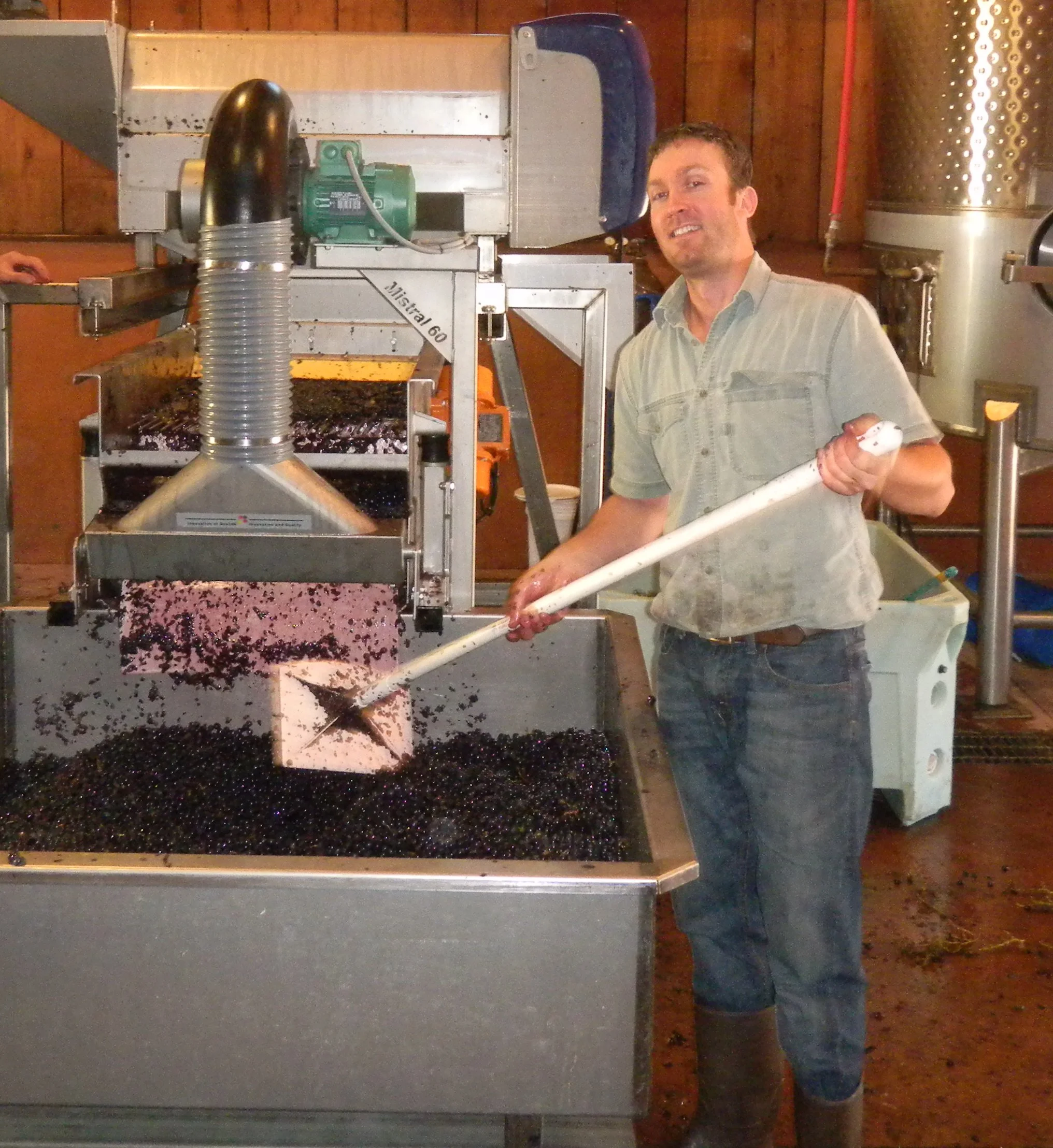
Fermentation step by step
In this solo episode, Jim Duane walks through recent harvest and fermentation decisions for the 2026 Chardonnay, Merlot, and Cabernet Sauvignon at Seavey Vineyard. He explains whole-cluster pressing and press cuts for Chardonnay, why he allows some early juice oxidation, and how he handles settling, nutrients, and barrel fermentation. For Merlot, he covers fruit processing, a cold soak, tartaric acid adjustment, native fermentation, nutrient timing, pump-overs, and malolactic bacteria.
Jim also discusses how vineyard conditions and juice chemistry shape his choices, including high potassium and pH, the misleading early titratable-acidity readings in red grapes, and why Brix alone cannot confirm that a wine is dry. He shares his nutrient-dosing approach and his plans for extended Cabernet maceration, tasting daily and keeping free-run and press wine separate.
This episode is brought to you by the Sentia Wine Analyzer from Scott Laboratories. Sentia is a handheld analyzer that gives you rapid, in-house measurements of five key analytes: Free SO₂, acetic acid, malic acid, glucose, and fructose. There’s no extensive training, calibration is automatic, reagents are minimal, and tests cost just $2 to $6 each. It’s built to fill the gaps between your existing QC checkpoints, whether you’re tracking VA trends, checking free SO₂ in barrels during topping, or confirming the end of alcoholic or malolactic fermentation.
Sentia isn’t meant to replace reference methods or outside labs. It makes routine analysis more accessible and affordable, especially for smaller wineries or those far from a testing lab. Learn more at scottlab.com/sentia-wine-analysis. Inside Winemaking listeners get 10% off a new Sentia analyzer with code SENTIA10 through their Scott Laboratories account. Offer for a limited time, limit one per customer.
Check out the Fundamentals of Winemaking Made Easy video course
-
Episode 224: Fermentation Step by Step
Guest: None (solo episode)
Recorded: October, 2026
Jim Duane:
Hey folks, welcome back to Inside Winemaking. This episode is brought to you by the Sentia Wine Analyzer from Scott Laboratories.
Sentia is a handheld analyzer that gives rapid in-house results for five key wine measurements, including free SO2, VA, and residual sugars (glucose and fructose), with automatic calibration and minimal reagents. It's an affordable way to get more data between lab visits, especially for smaller wineries.
And for listeners of this podcast, Scott Laboratories is offering 10% off the purchase price of a new Sentia analyzer. Simply use the code SENTIA10 when purchasing through your Scott Laboratories account. That is S-E-N-T-I-A one zero.
This is a limited time offer, and it's limited to one per customer. You can find a link to this in the show notes for this episode on your podcast player or at the website, insidewinemaking.com.
Okay, before we get into today's chemistry and fermentation episode, I want to tell you about our next Inside Winemaking trip, next June, from the 16th to the 23rd. I'm taking a small group to the south of France.
We will visit two wineries each day and sit down to a big, leisurely lunch. We'll start in Aix-en-Provence, touring the vineyards around Montagne Sainte-Victoire, the [...]
[...] you know, additions, how I was going to ferment the wine, including all the chemistries. And I've chosen some lots that needed some manipulation specifically, so we'd have more to talk about.
So that's what this episode is going to be. So, just me. Okay, let's get right into it.
---
I'm going to start off with a Chardonnay, just so we can go chronologically, in the order of the lots that I picked. These aren't quite wines until they're done. They're just specific lots that I have picked.
I wanted to pick one white and a couple of reds, and we're going to start with Chardonnay here. So on the 21st of August, I picked this Chardonnay lot. This is at Seavey Vineyard. That's where I am full time.
So this is Napa Valley, northern Napa Valley. St. Helena is the postal address, but it's the Napa Valley AVA. It's just south of Howell Mountain.
It's a warm spot, and that's part of the story of the Chardonnay here. So I picked this August 21st. Picked 2.014 tons. Brix came in at 22.6.
Let me get to some of these other chemistries. Actually, I'll get there in a second. Let's talk about the processing first.
So we bring the grapes in. We pick at night, we get the grapes cold, and then we load the grapes directly into the press.
The vineyard crew does a really good job of sorting in the vineyard. If we have time during harvest, we'll usually go through the day before, pull leaves off of the vines, and drop any fruit that doesn't look good.
So there's sorting that happens in the field, because I'm not sorting these grapes in the winery. They come in macro bins, and we dump those straight into the press. That's what's called whole cluster pressing, so we're getting juice right away.
Okay, so I run through my press cycle. It starts at 0.2 bar, goes up to 0.4 bar, then 0.6 bar. Each of those squeezes holds for about three minutes, and then the press deflates.
Then it crumbles, which is winemaking talk. I don't know why you can't just say turn, but it rolls. It crumbles twice, and then it starts that sequence again: 0.2, 0.4, 0.6 bar, for the same squeeze time. Then it deflates again and crumbles again.
The third cycle will start at 0.4 bar and go up through 0.6, 0.8, 1.0. And I'm tasting the juices from each of these squeezes, because once I'm into 0.4 and 0.6 of that third squeeze, the juice is really starting to change.
It's browning a lot quicker. Its pH is increasing. I'm not watching the pH with a pH meter right there, but you could. And the flavor is really falling off.
That's probably what I pay attention to most when I'm tasting to make press cuts with my juice: the persistence of flavor. I want to make it clear that I'm separating sweetness from flavor, because all these juices are basically equally sweet.
It's just the flavor that is there and how long that holds in your mouth. Chardonnay is not a particularly flavorful grape, but if you taste juices at these subsequently higher squeezes, you can really taste how the flavor falls off pretty quick.
Once it starts to fall off and the juice is browning, that's usually after the third squeeze, at about 0.6 or 0.8 for me. I really don't even go above one bar.
I know a lot of people do, and make some very high quality Chardonnays or other white wines from higher pressings. I think a lot of it has to do with your specific press.
But for me, I'm really getting diminishing yields at the harder squeezes, and the quality drops pretty quick. So a one bar squeeze for someone else might be great juice, but for me it's generally not good.
So I'm getting pretty low yields on my Chardonnay, usually about 120 to 125 gallons per ton. I think normal people are at like 150, 160 gallons per ton. Big juicy berries could be even higher than that, but that's what I got.
---
Chemistries. Let's talk about these chemistries. Okay, so I picked on the 21st of August. The juice went straight to a tank.
No pre-gassing in the tank. No CO2, argon, nitrogen, any of that. I want these juices to oxidize on the way to the tank.
I'm not adding SO2 either. For most lots, I did not add SO2 to Chardonnay this year. Actually, this lot I did, but I'll talk about that in a minute.
But I want eight-plus hours without any SO2, without trying to protect the juice from oxygen at all. I want that interaction, that browning, as those phenolic compounds that are readily oxidizable do oxidize and drop out. I get a much cleaner white wine.
I did a great podcast with the ladies from Birdhorse, where they told me about how they hyperoxidize their white wine from the Evangelho Vineyard. I forget which grapes they were using, but it's one of my favorite wines in California.
It's so fresh and fruity, and they oxidize the shit out of that. So I've learned from that to not be so dainty about protecting juice from oxidation. That's not true for all grapes, but for my Chardonnay, that works well.
Usually, after eight hours, I will either add SO2, or if I'm not using SO2, I'll add my non-Saccharomyces yeast. We'll talk about that more in a minute.
Okay, chemistries for the Chardonnay. Same day, day of harvest, I sent it off to the lab. I got 22.6, and the lab got 23.2. It's not uncommon for me to see that much of a difference between my own densitometer and an outside lab.
Titratable acidity was 6.2. That looks good. Malic acid was 3.4 grams per liter. That's super high for where I am. I'm usually at around one to one and a half grams per liter.
So I was shocked to see over three grams. That's probably the first time I've ever seen over three grams per liter of malic acid in my Chardonnays.
It's just uncommon in northern Napa Valley, St. Helena. It would be totally common in a cooler spot like Carneros or Sonoma or anything coastal. Not a problem.
It just informs me that if I am going to put this wine through malolactic fermentation, there's going to be a real shift in the pH and the TA, because there's a lot of malic acid. At three grams per liter, I would expect to see, I don't know, one and a half, almost two grams per liter change in titratable acidity.
Maybe not that much. I don't know. I don't deal with these high malic acids.
Okay, the pH was 3.59. Now, that's a little high for Chardonnay. It's toward the top end of my comfort zone. I don't love that, but it is pretty common for the Chardonnay that I work with. Ideally, I would like to see Chardonnay at 3.2 to 3.4 pH.
Potassium was 1,975 milligrams per liter. That's definitely on the high side, and it's part of the story of why the pH is so high. All that potassium is creating a higher buffer capacity, which is going to lead to a higher pH, not necessarily a lower TA.
Okay, glucose, fructose. Who cares? My ammonia was 81. My alpha amino nitrogen was 153.
Put those together, and you get about, what, 234 maybe. That's YAN, yeast assimilable nitrogen, in milligrams per liter. That's high for me. I don't usually see stuff that high.
2026 has been an odd year for some of my chemistries. Anyway, that's fine. It means I don't have to add much in the way of nutrients.
---
Okay, so let's go back and talk about what I did to this wine. Let me get to my spreadsheet here.
So at the end of that harvest day, I did put SO2 into this lot. Normally I don't with Chardonnay, but I have this question I'm trying to answer, which is: how much free and total SO2 do yeast create on their own during fermentation?
You hear this in the media about wine all the time, especially with natural winemaking, that yeast create sulfur dioxide in the wine. It's true, but that doesn't tell you the whole story, because yeast create so little that it's never enough to protect your wine.
I'm going to call it 99-plus percent of all the wines I've ever made get to the end of fermentation and have zero free SO2. Yes, there's some total. Maybe it's 15, maybe it's 20 parts per million total SO2, but that's not going to do anything to protect your wine.
You need free SO2, and whatever free SO2 yeast may or may not create is bound up real fast. There's so much junk in fermentation, solids and sugars and all that, that it's going to bind up any free SO2.
So the whole narrative in natural winemaking about being totally cool not needing to add SO2 because the yeast naturally create it? Like, no, they don't. They do, but they don't. It's a fart in the wind.
Okay, that was a tangent I didn't see coming. But I wanted to see, so I added SO2.
I normally just add this product called Egide, which comes from Laffort. This is not a Laffort sponsored podcast, but I like their yeast and nutrients and all of their supplies, and they have great technical support.
I had Jillian Johnson DeLeon on the podcast a couple of episodes ago, and she was super helpful in getting through all sorts of technical stuff for fermentation management, specifically nutrient management with yeast and bacteria. So check out that episode if you want to get nerdy again.
But Laffort's great, and they offer support. You can always call them with your chemistries, and they will help you run through a nutrient program. I don't know if everyone knows that, but they are a great resource. So is Scott Labs, and so is Gusmer Enterprises.
Okay, so I put in SO2 at 30 parts per million. That is 30 parts per million as total SO2.
I don't measure my free SO2 after I put it into the juice, because I know that if it's not zero, it's approaching zero within 24 hours. You're just going to have all that free SO2 bound up with sugar.
But in the meantime, the SO2 does function to inhibit the browning enzyme, polyphenol oxidase. So you will see the color of your juice lighten up, and you won't see as much browning.
You will definitely see browning if you're going with that other, hands-off approach, let's call it the old world approach, of not using any gas or SO2 and letting some early oxidation of the juice take place.
So for most of my Chardonnay I didn't add any SO2, but for this one lot I did this year, because I wanted to see where my frees and totals ended up after fermentation. I don't have the data in front of me, but I can tell you the frees were all zero.
Okay, let me finish this. I added SO2 at the end of the day, and then I did put some CO2 into the headspace, so I am doing some protection from oxygen later. You've got to pick your amount of oxidation, and everyone has to have their own conversation about what they want to do.
---
Next day, the tank was chilled. I've got this in a little porta tank. It's just got a back wall chiller. It's not the most efficient ever, but I just turn that on and try to get the juice down to 50-ish degrees Fahrenheit, and then the juice settles out.
So I picked two tons. I had 180 gallons worth of juice, and that's not a lot. So the amount of lees, or not really lees, it's more just grape solids, that's going to cold settle overnight is not a lot.
I don't even use any sort of racking wand in my tanks. I just take juice out the bottom valve of the porta tank. As I'm running the juice through my pump setup, I discharge the first gallon or so, because it's going to be pretty goopy.
I would say leesy, but again, it's just grape solids. And then that thin layer of solids settles really well in the tank, so I don't have to worry about sucking it out as I'm pumping.
So I'm pumping out to another porta tank, and in that porta tank, I will at this point pre-gas it with some carbon dioxide. I put in some little CO2 pellets, little turds, before I pump the juice in, to give it some protection from oxygen. I'm not getting real crazy about this, though.
And then I just get rid of those solids. I have worked at wineries in the past where we would send samples up to the lab to check solids. We had a centrifuge where you could put 100 mils of sample in and spin it, and then you could see your percent of solids.
We were often targeting 1% solids, and if the juice was less than that, we would actually add some of the solids back into the juice. I think they help keep nutrients and yeast up in suspension. That was the idea there. But I'm not doing any of that here. I'm just racking clean juice.
Then it goes to this secondary holding tank, and in that, I do any adjustments I need. If the Brix was super high, I would add water. If it needed tartaric acid because the pH was too high and/or the TA was too low, I would do that here.
You want to do all these additions before you start fermentation. That is the ideal time to do additions, if you have to do them.
And then I added nutrients and inoculated. In this case, with my YAN, my yeast assimilable nitrogen, being 234, pretty high, and a low starting Brix of somewhere between 22.6 and 23.2, you never know exactly, I didn't need a lot of nitrogen.
So I used a little tool that I built on Claude, based off of that podcast episode I did with Jillian Johnson DeLeon from Laffort, where she walked me through how much to use of two nutrients, Nutristart and Thiazote.
Nutristart is a complex nutrient blend that has a little bit of diammonium phosphate in it, which gives it some nitrogen. I'm not using Nutristart Org, which is the other, organic version. It has a little bit less nitrogen, because you can't put diammonium phosphate in an organic nutrient addition for wine.
And then Thiazote is what people know as DAP, diammonium phosphate. That's your quick feed ammonia for feeding yeast.
Again, that episode with Jillian was great. She explained the timing and how you want to use these two categories of products: your complex nutrient blend, in this case Nutristart, and your quick ammonia nutrient, your diammonium phosphate.
In this case, I'm using a product called Thiazote. It's got some thiamine or something in there too. That's why they call it Thiazote. Laffort has the most ridiculous names for wine additives of all the companies.
Okay, so with this thing I built with AI, you put in your starting Brix, you put in which nutrients you want to use, and you put in your starting YAN, and it calculates how much you need to add in two different doses. Breaking it up into two doses is something that was discussed on that previous podcast, along with the reasons for it.
For my first dose, it calculated 30 grams per hectoliter of Nutristart, the complex nutrient blend, and zero Thiazote. The YAN is high enough that I don't need to add extra straight nitrogen.
So I added that on August 22nd. Again, that's the day after harvest. I racked in the morning, did the additions after racking, and then sent the wines to barrel to ferment.
---
Okay. The only thing I'm going to say about barrels is that we just pump the juice to barrel. Again, I pre-gas with some CO2, which makes it extra hard to fill the barrel, because the CO2 sublimates and makes a bunch of vapor that you can't see through.
So when you're holding your flashlight trying to see the juice come up, it's nearly impossible. But this is just how you have to roll.
Fill the barrel up to about 52, 53, or 54 gallons of juice, leaving about six to eight gallons of headspace for fermentation. Once the juice is up in the barrel, put another turd of CO2 in there to protect it a little bit more. Then it's going to ferment based on temperature.
In this case, my barrels are in the barrel cave where I also store previous vintages of wine. All my barrels are in one room, so I don't have a lot of optionality to heat and cool the room.
I would previously keep the barrel room at about 55 degrees Fahrenheit. I let it come up to... no, I didn't for the Chardonnay. I kept it at 55. Actually, I went even a little bit colder. I think I took it down to 52.
Because then your fermentation is going to get up to about 60 degrees anyway. Wood's a pretty good insulator, and there's a little bit of heat being generated in that fermentation.
So those fermentations are actually happening in the 60 to 65 degree temperature range, with the room set at about 52 degrees, and all the other finished wines from the previous vintage sitting at 52 degrees.
Later, I have to bring the barrel room temperature up to 60 degrees, which essentially means turning my chiller off at this point in the season, when I put my new red wines into that room. A lot of those are still finishing primary and ML fermentation, and at 52 degrees that happens real slow, especially ML.
So that's that Chardonnay. What else? Okay, so I inoculated on the 22nd of August after doing the nutrient additions.
I did not add any tartaric acid to this, by the way. I think I glossed over that. My pH was 3.59, and in retrospect, I think maybe I should have added some acid. That pH makes me a little bit uncomfortable.
The TA was in the low sixes, which means I had some room to add tartaric acid. I don't really want to add more and end up with a TA over seven grams per liter. If this was starting at 6.2, that gives me about 0.8 grams per liter of room to add acid. So I could have. I didn't, though. And I'm okay with that.
So then fermentation has got to start. What am I doing in the intervening days? It was a couple of days, I think three days, before fermentation really got going.
All I'm doing is stirring the barrels once a day, stirring the juice once a day. I just want to kick the yeast and the nutrients back up into suspension and make sure nothing's settling out. And that's that.
Maybe I'll drop in a turd of dry ice again, just to protect from some oxygen at this point. I only want that oxidation right up front, in those first eight hours. For me, in these Chardonnays, that works well.
Then on August 25th, I have a note here that I added nutrients. I added a dose of Thiazote. Using my new AI tool, I calculated 21 grams per hectoliter of Thiazote, no Nutristart needed, and that was the final nutrient addition.
So I just pull some juice out of the barrels and mix up that Thiazote, which is a white granular powder. Let's be honest, anyone that's ever worked with DAP knows it's mostly chunks. But if you buy a fresh batch, you have fewer chunks.
Anyway, I mixed that up into some juice and then divided it evenly back into all the different barrels in this lot. I used my barrel stirrer to stir it up a little bit and called it good.
All I needed was that one nutrient addition for this lot, so this was a pretty easy Chardonnay. I think that's it for the story.
Oh, I didn't mention the yeast that I used. I really don't care about yeast that much. Let me look at my notes. I used this one from Laffort called X16.
It's got some really cool Chardonnay-looking yellow fruit on the front of the packaging, and that's really how much I care about yeast, because I don't think it matters. It did well anyway. Fermented well.
---
Let's switch gears and talk about Merlot next. We're going to move to the 8th of September, when I picked Merlot.
This is my nicest Merlot. This is some really nice Merlot. I'm very excited about this Merlot from Block One New.
Picked it on the 8th of September. Brix was 24.3. We picked 4.652 tons of this, which gives me an estimated yield of 591 gallons.
What I do is just take my tons and multiply that by how many gallons I think I'm going to get per ton. My historical average with red wines at Seavey is 140 gallons per ton. It's really between 133 and 143 every year, so it's actually really close to 140 gallons per ton.
That's one of the great things about working with the same vineyard blocks year after year. You have these assumptions that you have to make with any wine, but you can really tighten up the precision of your assumptions when you're working with the same vineyards. I really like it.
Okay, so what do we do with this? We picked it at night, it came in cold, and we processed the grapes, which is a big word for pulling the grapes off the stems with the destemmer and then sorting the fruit.
I have an optical sorter. It's like having a Tesla back in 2021. If you got a Tesla, you had to tell everyone you got a Tesla. Maybe not 2021, but whenever it was cool to get a Tesla.
When you get an optical sorter, you've got to tell everyone about it. You can't stop talking about it for a couple of years. Anyway, I really like that machine. It's made my life so much easier. That's why I talk about it.
Processed grapes go to tank. In this situation, I'm moving grapes to tank using a peristaltic pump, directly to tank with a three-inch line.
That peristaltic pump does a good job of breaking most of the berries but leaving some whole. I'm not looking for carbonic maceration here.
In the previous era of equipment and our processing line at Seavey, prior to 2020, we did everything 100% whole berry. It made for some challenging and less homogeneous winemaking, and I think it caused some problems.
Specifically, when you have a lot of really intact whole berries in your tank that don't pop open at all during fermentation, then you get to the press and you have a big discrepancy in potential alcohol between your free run and your press.
Not to mention, you're making your additions of nutrients and yeast or whatever you're putting in based on a certain gallons per ton. But the actual gallons per ton of juice that's liberated and free and moving in the tank is significantly lower. It made things awkward.
So I really like that we're breaking some berries on the way to tank. I don't want to be crushing seeds. No one wants to crush seeds, because seeds are bitter. But you want to pop your berries as gently as possible on the way into tank. In my situation, I'm pretty happy with my peristaltic pump.
I set the chiller on the tank to 50 degrees. Usually I get grapes into a tank between 55 and 65 degrees Fahrenheit. That's just the reality of my situation. We don't have a must chiller, and I don't think many small or medium wineries have must chillers.
So a lot of times, you just have to deal with your grapes at whatever temperature you've got. And I know a lot of people don't even have the luxury of having a professional crew to pick their grapes at night.
I mention that because if I did have a hot day or a hot night, a hot situation, that sounds funny, and had to pick grapes warm, I would start my fermentation earlier.
I'm not going to turn the chiller on and try to cool down a tank of grapes that's not going to cool down. It gets awkward. I get nervous about bacteria starting to take off in a warm situation before the yeast are going.
So I would potentially inoculate, or maybe even do my little cheater inoculation, where I take a couple of gallons of juice from a tank that's fermenting and dump it in another, and that starts things off. But cold is ideal.
Whole berry pisses me off. Why another rant? Okay.
---
On the way to the tank, I was dosing in a non-Saccharomyces product. I know it's funny to define something by what it's not. This product is called Egide, which is the Laffort version. All the other suppliers have their own names for their own versions.
It's two genera of yeast that are not Saccharomyces: Metschnikowia pulcherrima and Torulaspora delbrueckii. That's a lot. They're sacrificial yeasts that go in and protect your nitrogen and keep bacteria at bay.
So for those two functions, they are a great substitute for SO2, potassium metabisulfite. They do not inhibit the enzyme polyphenol oxidase, so keep that in mind. You're essentially covering two of the functions of SO2, but not all three.
Anyway, for red grapes, this is great. I'm not worried about the enzyme action with red grapes at all.
I think the main reason winemakers are adding, or should be adding, any sort of SO2 or sulfites to juice before fermentation, which is what most people do, is to keep bacteria at bay. Maybe knock back some non-Saccharomyces yeast that are sensitive to SO2. But really, it's about making sure bacteria don't take off.
You don't want your bacteria getting a foothold before the yeast get a foothold. Once the yeast get going, they're dominant. They're bullies. They keep the bacteria at bay. But you need to get the yeast started first.
Whether you're doing what I do for the most part, native fermentation, just waiting for those yeast to take off, or any other situation, you want to manage the bacteria before the yeast have a dominant foothold. I think that's what it comes down to.
So I use this product. We dose it in at three grams per hectoliter on the way to the tank. I've just got a little bucket where I take this freeze-dried yeast. I don't have to do a warm rehydration like with other yeast.
You just dump it in cold water, mix it with a whisk, and then slowly dose it into the hopper, which is where I spend most of my time during harvest.
On the way to the tank, I also added some dry ice pellets, or turds, to the grapes. That helps cool the grapes a little bit, although you have to add a really significant volume of dry ice to reduce the temperature of red grapes, so that's expensive and tough.
Dry ice then obviously sublimates to carbon dioxide, which can form that blanket layer on top of your grapes and protect from oxygen. Two benefits, and you get to say turds.
Okay. I see in my notes that I added some acid to this lot, so let's go look at the chemistries. The chemistry is from the 8th of September, which is my day of harvest.
Brix 25, titratable acidity 3.22, malic 1.39, pH 3.94. Okay, that pH is a little warm.
My line in the sand for when to add tartaric acid is 3.9. If my juice is above 3.9, I will add tartaric acid. I'll look at the TA for shits and giggles, but it never matters.
My TAs are always so low, and in this case it said 3.22. I'm not going to add acid and end up with a TA that concerns me, because my TAs are always so low. When this wine is finished, it will be between 5.5 and six grams per liter titratable acidity.
I've referred to this reading in the past as the TA trip-up. Anytime you have red grapes, especially after they've soaked on skins and leached out potassium, once that comes to equilibrium in a couple of days, your titratable acidity is just going to go to some false low reading.
If you check your red juice right after you harvest, within a couple of hours of processing your fruit, you might get an accurate reading. But by the time you come back the next day, and especially a couple of days in, that TA is going to drop. In my case, from five down to 3.2.
But it's not actually 3.22, because without touching it, after fermentation, like I said, this will be six. It'll always be about six. So be careful of that. Just don't think about titratable acidity in red grapes once potassium has leached out.
---
Okay, so I said my pH was 3.94. I'm going to add some acid, and I'll talk through how much in a second. But let's finish with the other chemistries, because they are relevant.
Potassium was 2,132 milligrams per liter. That's high. Anything above 2,000 milligrams per liter is real high potassium, so that's part of why the pH is super high.
I did see in this vineyard that there was a lot of basal senescence, a lot of yellow leaves down around the fruit zone. So I knew potassium was dumping from the leaves to the fruit. That's what happens when you see the leaves yellowing on a vine like that.
So I expected it to be high, but this is real high. That just tells me that with a pH of 3.94 and high potassium, I've got a lot of room to add acid. In this case, I ended up adding 1.0 grams per liter.
I didn't do any sort of acid trial, which would be the gold standard. That's where you take your juice and measure pH and TA, and then you dose a bunch of other samples sequentially with higher rates of tartaric acid. I would go from 0.25 grams per liter up to two grams per liter in a trial like that, and then you measure the pH and TA.
If you've got a lab technician, this is great, but I don't have that. I don't have time for all this.
I even worked with a winemaker once who would taste these and make decisions based on taste. I just thought it would be very difficult to taste acidity in a juice where you have, say, 24% sugar. That gives some real texture to the juice that's not going to be there in the wine.
To say, "Okay, this one tastes good, let's go with this one," and translate that into the final wine, I think was a little bit weird. So I think it's probably more reasonable to make your decision on tartaric acid additions based on chemistries here.
That's not something I usually say. I like to do things by taste more often than not, but on this one, chemistry would be smart. But again, I didn't do that. I just picked a number.
I know from experience that if I add one gram per liter to this red juice, this Merlot that I've worked with in the past, I would expect the pH to come down to about 3.7 to 3.75. Maybe not quite that low, given the high potassium, but that would be my experience.
And the titratable acidity, I'm not going to see it come up a full gram per liter. It'll probably go up 0.6 or 0.7 grams per liter, so 60 to 70% of what you added will show up in the TA.
Okay, that was a lot. Let's get back to Merlot here. What did I do? Okay, it's in tank.
I jumped the gun a little bit. The timing for that acid addition would be about three days after the day of harvest, so pre-fermentation, during that cold soak period.
I'm going to have that chiller on the tank for the first day, and then I'm going to turn it off. I just turn it up to 82 degrees or whatever it is, so the chiller won't come on again until fermentation has really heated up and is going. And I'm not heating it up. This is all going to be natural at this point.
Where was I? Okay, grapes in the tank, cold soak. I just let things go for those first three, four, or five days before fermentation starts.
I'll do a pump over once per day, and try to move about one full volume of the juice during a pump over. I'll add a scoop of dry ice over the top of the tank once a day after the pump over, and that's about it.
I mean, I'm not sitting around eating peanuts. We're processing other lots. But on this lot specifically, I'm just going to let it go until fermentation starts.
For me, I usually expect to see fermentation start natively once the temperature gets above 65 degrees Fahrenheit. That could be three days, that could be seven days. It's mostly based on the temperature of the grapes once they get to tank.
The difference between 50 and 55 is significant. That could be another two full days of extra cold soak.
I do have the capacity to warm these tanks, so if I get something that's too cold for too long, like more than seven days, I will turn on the warming, and that usually gets things going.
Also, I can cheat, like I said before, and take a couple of buckets of fermenting must from one tank and dump it in another. You don't want to do this with your Merlot into Chardonnay. But Merlot to Merlot and Cab to Cab, for me, that's fine.
So on the third day, I made that tartaric acid addition. I take some juice from the tank, dump the acid in over the top during the pump over, and really mix it in.
And then I'm going to add my nutrients. No, okay, I'm not going to add my nutrients until I see fermentation starting, in a situation where I'm just letting the native ferment go.
So my cue that fermentation has started, and that I need to add my first dose of nutrients, is when I see those first signs of fermentation. You can smell it in the room, you can smell it in the tank, and you can taste a little bit of fizziness in the juice. You can feel that on your tongue.
And obviously, if your Brix is moving, that's a sign too. But I can usually smell fermentation starting before the Brix will actually start to move, so I like to get those nutrients in then, fast.
---
The way I'm adding the nutrients isn't much different from a more standard, conventional situation where you're inoculating with yeast.
Whenever you want to add your yeast, I would never recommend people add their yeast on the same day that they're harvesting grapes, even if the grapes are really warm. Let it go until the next day at least. That's helpful. It just makes me feel good.
However long you want to cold soak is a decision you make for the style of your wine and your situation, your facility. Your tolerance of risk is another factor here.
I can take big risks at Seavey because we are only making wines from the one estate vineyard where we are. There are no other grapes coming in from any other area, ever. So I'm very isolated. I feel kind of quarantined, and that gives me a little bit more leeway.
I think that's one of the great opportunities at Seavey in making an estate wine like this: I can take some risks like that. I don't want to be cavalier, ever, but native fermentations work really well for me.
I don't know if I have one yeast, but I operate as if I just have one house yeast. I know that's not true, but it sounds sexy. If I was in France, you would believe it. If I had a French accent and I was charming, you would believe it. So let's go with it.
So I work as if I just have this house flora of yeast, and when I take juice from one tank to another, I'm adding the yeast that I assume ferments all of my red wines.
I do inoculate Chardonnay and rosé separately, and then I work fastidiously to sanitize all the equipment that touches that yeast, so it does not inoculate my red grapes. Don't ask me why. I just feel like it's not cool to have Chardonnay or rosé yeast in your red wines. It just doesn't feel right.
Okay. I picked this on the 8th, and on the 10th I'm adding nutrients, so that lot probably came in pretty warm.
We certainly had some warm days at the end of September, and the first week of October this year was between 95 and 99 for five days. That was real. I picked my last grapes in anticipation of that, because they were ripe enough that we could. But that was pretty wild heat for early October.
Okay, September 10th. I add Nutristart at 30 grams per hectoliter and Thiazote at 11 grams per hectoliter.
Let me go back and look at the YAN in the chemistries. Ammonia was eight, and alpha amino nitrogen, or NOPA, was 83. Add those together, and it's about low 90s. About 91. I can't do math. So 91 for the YAN.
I put that into my special AI tool. I'm going to try to find a way to make this available, because if it's helpful for people, I'm happy to let people use it.
You just put in your starting Brix and your YAN, and you can even put in your tons, and it converts that to gallons using whatever coefficient of gallons per ton you want. Anyway, cool tool.
It broke out this first stage addition, right at the start of fermentation on the 10th of September: 30 and 11 grams per hectoliter, respectively, of Nutristart and Thiazote.
Then three days later, on the 13th of September, when the Brix got down to about 20, I did my second addition. That was 24 grams per hectoliter of Thiazote, and I did not need to add any Nutristart. Cool. That's all I added.
After that second addition of nutrients, the next day I did add malolactic bacteria. I don't add yeast. I do wild fermentations for reds, but I do add bacteria. So I'm like a half bad boy. Half, yeah.
I need to add bacteria because my cellar is cool, and if I don't, my red wines just don't go through malolactic fermentation. I know everyone thinks, "Oh, but when it warms up in the spring, the cave warms up." Yeah, well, my cave doesn't warm up. So I need to add bacteria so I can get malolactic done early.
So I co-inoculate for most of my red fermentations. I just use the freeze-dried stuff. Nothing special. I try to find the cheapest I can find, and whatever the rate says to add, I divide by 10.
So I add 10% of the dosage, because you don't need to add a whole lot. If you get bacteria in early, during fermentation when the wine is warm, I think they build up their populations, because I see much quicker malolactic fermentations in these situations.
That's helpful for me, because I have to get wines to barrel in order to bring in other lots from the vineyard. I'm tank limited in the winery during harvest, so wines have to go to barrel, to that colder environment, and I need to get malolactic fermentation going.
I call it co-inoculation, which is slightly a misnomer, because I'm not adding bacteria at the time of adding yeast, because I'm not adding yeast. But you can imagine it as whenever the yeast are present and taking over. I'm waiting until my additions are done.
So the day after the additions, I add bacteria. I just dump a little over the top, and like I said, 10% of the recommended dosage. We can save some money here.
And my ML fermentations are usually done at the same time my wines are sugar dry: done with primary fermentation, less than two grams per liter sugar, glucose plus fructose. How many other ways can I say it?
---
I just want to bring home the point that Brix does not tell you dryness. I can't say this enough. Whatever Brix reading you get, whether it's negative 1.1 or negative 2.3, that does not tell you if your wine is dry or not.
Brix will tell you when your wine has stopped fermenting, because the Brix reading has stopped changing. But the specific gravity of a wine is lower than one, lower than water, because of the alcohol, and your alcohol varies with whatever wine you've made.
There can be other junk in there affecting the reading too, because a densitometer is just reading density. It doesn't tell you when your wine is dry. You've got to send your wine out to a lab or do real analysis to know your glucose and fructose, and when that is below two grams per liter, your wine is dry.
And stop talking about Brix. Thank you, Jesus Christ.
Okay. Next, Cabernet. Should we talk about Cabernet? Well, no, let's finish Merlot.
So I really ramped up the pump overs once I saw those first signs of life of fermentation. That would have been on the 10th of September.
I have a fixed-in-place pump over system. That's a humble brag. I love this thing, because it takes about two hours off of my day, every single day during harvest, not having to lug a pump around from tank to tank. I know not everyone has this luxury, but man, is it a luxury. It's the best.
So I go over and flip the switch on the tank. Well, okay, that's not entirely true. We don't have catwalks, so I have to roll the ladder over to the tank and open the venturi on top, so oxygen can get in during the cycling of the must.
This is weird, because it's not juice. It's fermenting must, but it's just liquid. What's that word? It's not wine yet. It's must without any solids, because I have really cool in-tank screens that keep seeds and skins from moving through the pump over system.
So like I said, I have to get on top of the tank and open a valve, and also hit a switch. It's some work.
I do a lot of pump overs early, three, four, five times a day, and I run it for many volumes. You calculate your volume of juice based on your tons in the tank and your coefficient of gallons per ton. Then you know how many gallons per minute your pump is running, and you can time how many minutes to run your pump.
That venturi on top pulls in air, which feeds the yeast oxygen, so that's pretty cool too. I do less and less intensive pump overs as the wine comes dry.
Below five Brix, I'm going to close that valve on top. I don't want any more oxygen at that point. We just do closed-system pump overs.
The headspace of the tank is 100% CO2 at that point. It's super saturated, so there's no reason to use any dry ice or any sort of gas. Just let it do its thing.
Then the temperature comes up, and I want a controlled temperature. I don't want to see it spike above 82, 83, 84 degrees.
With 4.6 tons in one of my tanks, that chiller will click on. It would get above 90 degrees if I didn't chill it. But at three tons or below, I can often get away without having to use any chilling at all.
That can be helpful, because chillers are expensive, and mine broke at the beginning of harvest. So that was fun, having to go out and get a rental one at the beginning of harvest.
Okay, and that's that. I just let the wine go. It went dry in tank, and then I pressed it well after it was dry. Then it went to barrel.
---
Okay, let's talk about Cab. I picked Block Three Old. This is the best Cab at Seavey, by the way. This is the jewel of Seavey Vineyard: Block Three Old, planted in 1993.
It makes the best wine from the property every year, and I can't tell you why. I also can't tell you how many hours of my life I've spent thinking about why. I don't have the answer, but magically it does, every year.
We picked 5.7 tons at night. Same sort of processing system. I added Egide on the way to the tank.
5.7 tons gave me a predicted yield of 803 gallons. That's a lot of barrels for that lot. That's great. We definitely got more than three tons per acre, which we did not see a lot of this year for that block.
Okay, YAN was 43, super low. Let me actually go look at these chemistries here.
I did three days of chemistries for this one. I sent one sample on the day of harvest, and then one on each of the next two days, mostly so we can talk about pH and the changes here.
The Brix were basically all the same, 25.2 to 25.3. TA on the day of harvest was four, and then it dropped down to 3.5 the next day. The day after that, it didn't drop anymore. It stayed at 3.5.
Anyway, it's good to see how the TA drops, because again, it's the TA trip-up. It's not actually dropping.
Malic acid was 1.3 to 1.4, pretty normal for me. pH started at 3.73, the next day it was up to 3.82, and the next day it was up to 3.89. That gives you a sense of pH really moving because of the buffer capacity.
Potassium on this was between 1,850 and 1,900, so high-ish, but not crazy. Glu-fru, who cares? I don't.
Ammonia: there was no ammonia. It was less than five, below the detection limit. And the NOPA, aka alpha amino nitrogen, was 43 to 55.
It changed all over the map between those three samples. But there's always going to be some variance in the samples you send to the lab, and small differences like 10 ppm in nitrogen don't mean much.
Okay, pH 3.73. I don't need to add acid. Okay, no, it came up to 3.89. Ah, but it didn't cross my threshold, so no acid. See what I do?
Oh no, I lied. I added 0.3 grams per liter of tartaric acid. That's a decision I made because the potassium was actually high.
I knew that pH was going to be well over 3.9, probably closer to 4.0, by the end of malolactic fermentation, and I don't feel comfortable with my pHs at 4.0. So I added a little bit of acid, 0.3 grams per liter. Again, I just made that decision.
We picked on the 30th of September. On the 6th of October, I made the first nutrient addition, which means fermentation had started seven days later.
With this super low YAN, only 43 because there was no ammonia, the nutrient dosing is going to be higher. So for the first dose, Nutristart and Thiazote, 35 and 34 grams per hectoliter, respectively. And fermentation really got going.
Usually when you dose with nutrients, you do see temperatures move up. The yeast have built up their populations at that point, and you're giving them nutrients that help them metabolize faster, so they create heat.
Then on the 7th of October, the next day, I did my next dose of nutrients. If I'm starting at a Brix of 24.8, with that first dose on the 6th, I would have seen the Brix just start to move, probably breaking below 23 Brix.
So the next day they're down to 20 Brix. I know at this point I've got to get it in quick, because the next day it could be 12 Brix, and I don't like adding nutrients that low. That's something Jillian and I also talked about on that Laffort podcast.
So the next day I added five and 26 grams per hectoliter, respectively, of Nutristart and Thiazote. So more Thiazote at this point. The secondary dosing is usually where you get in your Thiazote, and I just add a little bit of Nutristart to make myself feel good.
---
Then it ferments, and eventually I will drain this. I haven't yet. It's still on skins. I'm recording this on the 20th of October, and I picked this lot on the 30th of September.
This is the best lot, and I'm seeing really nice, elegant, soft tannins in 2026. I've talked to some other winemakers who are also reporting low tannin numbers, for those who are actually measuring these things analytically.
It's nice for Seavey. We're a big tannin site, so these lower tannin years are, I think, where we really shine. So I'm excited about our wines in that regard.
But I'm going to do extended maceration, and I'm just going to taste this wine every day. I know from experience that this wine is going to build. There's going to be more and more tannin extracted every day.
I know that empirically. That's one of the things I studied when I was at UC Davis. So I want to build as much of a wine as I can, as much of a mid-palate, without it becoming astringent and tough. That's what I'm waiting for.
I don't have the ability to warm these tanks. This one's currently about 72 degrees and dropping. It's 5.7 tons, so it's got enough thermal mass that it's holding its heat pretty well. The tanks I have this lot in do not have a jacket for warming, so I just have to let it do its thing.
I would never let a maceration go below 60 degrees Fahrenheit, because then you're going to start to oxidize your wine. We actually saw that when measuring dissolved oxygen in cases where we were doing micro-oxygenation.
I know from the long-ago days when I got to play with some of the micro-oxygenation stuff that the system works until you go below 60 degrees. Then you start not micro-oxygenating, but micro-oxidizing. Every time it dropped below 60 degrees, DO picked up.
I don't want any dissolved oxygen in my wines at this point. So that's one critical reason I might decide to drain and press.
But in my case, it's holding at 74 degrees, so I'm going to let this keep going. It tastes great. The tannins are nice. I'm happy with the texture of the wine, and I'm happy to have a little bit more.
I don't know when I'm going to drain and press this, but when I do, it'll be a drain, and then I will separate the free run, and that's what will go to barrel as this lot.
After an extended maceration, especially if I'm going north of 27, 28 days, and especially over a month of maceration, the quality of the press wine takes a hit. So I don't love those press wines so much.
I've learned not to reincorporate those press wines back into the free run lot. I hold them separate and make a very nice wine, but it's not the same as the drain lot.
I think I got through everything? I talked way more than I expected to talk. I apologize for all the rants. It's harvest, I'm a little spicy. Maybe you can tell.
---
I'm also really excited about France. I'm booking the hotels now in Aix-en-Provence, which I think is how you say it. That's where we're going to stay when we spend our three days in Provence.
Then we're going to go up to the town of Avignon, where we'll be based to visit Châteauneuf-du-Pape for a day, and Gigondas for another day. I can't wait.
I've got my Provence and my Avignon books, and I'm learning. I'm starting to practice my French. Super excited to go. Okay, so I guess that was a plug for the trip.
What else do I need to talk about with the wines? I feel like I've talked so much. I should just end this. Yeah, let's end it. Okay.
What else do we need to talk about? Show notes are at the website, insidewinemaking.com.
I'm going to read the podcast sponsorship from Scott Labs. This episode is brought to you by the Sentia Wine Analyzer from Scott Laboratories.
Sentia is a handheld analyzer that gives rapid in-house results for five key wine measurements, including free SO2, VA, and residual sugars, with automatic calibration and minimal reagents. It's an affordable way to get more data between lab visits, especially for smaller wineries.
And for listeners of this podcast, Scott Laboratories is offering a 10% discount off the purchase of a new Sentia analyzer. I don't know exactly how much they are. I think they're like 1,600 bucks. I apologize for not knowing exactly, but 10% off is real money. So thanks to Scott Labs for the great discount.
This is a limited time offer, and there's a limit of one per customer. You can find that link in the show notes on your podcast player or on the website, insidewinemaking.com.
Thank you. If you made it through all this, God bless you, you're a soldier. Hope you had a great harvest yourself.
I talked about the France trip, and I'm also talking about Glasvin. They've got cool stemware, really beautiful stemware. I especially like the Champagne glasses. That's my favorite. I love the shape that they have. You can look at all the stemware options. There's a tab on the website for Glasvin.
And then check out the Vintage Wine Opener. There is a well-known product that has occupied this market with a monopoly for many years, and that product is great. This is 90% of that product for 30% of the price. It's pretty awesome.
All right, thanks, everybody, for listening.